Slide bolt, magnetic catch, or keyed cylinder - the closure system that actually works on your loft door is determined by frame profile depth, glass type, and which side the door is operated from. Personal taste matters, but it comes second. This guide walks through the three main hardware categories, explains what the steel frame allows or rules out, and gives you concrete price ranges so you can make an informed decision before ordering or retrofitting.
Three Hardware Categories - and When Each One Makes Sense
Slide Bolt: Privacy Without Security Claims
A powder-coated slide bolt is the most straightforward closure option for a loft door. It works well wherever a key is not required: bathrooms, dressing rooms, and utility spaces are the obvious candidates. The bolt prevents the door from swinging open unintentionally - caused by a draught through an open window, or by children pushing against the panel - but it offers no protection against deliberate entry, since it cannot be operated from the opposite side.
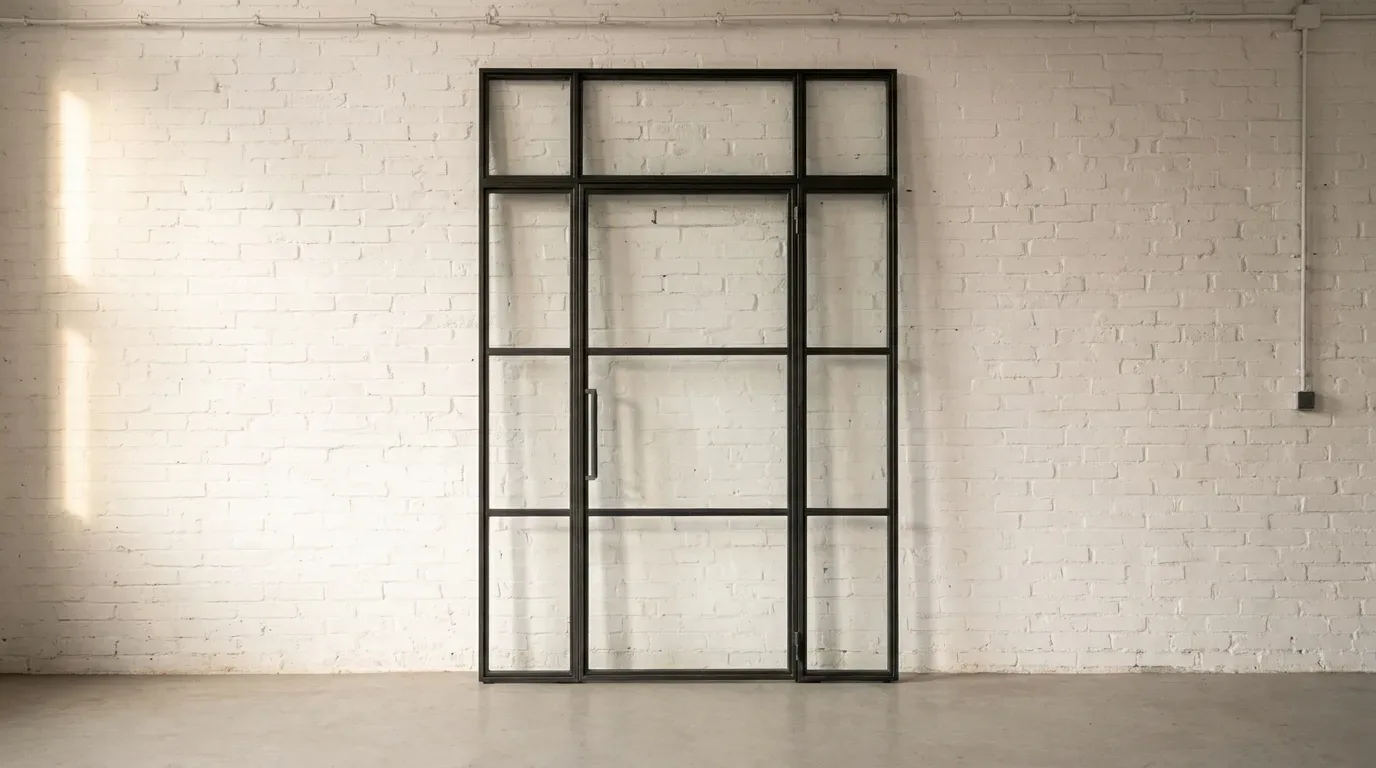
The bolt attaches exclusively to the steel frame - never to the glass. In practice this means the frame profile needs M5 or M6 threaded holes at the mounting point. At Manufaktur X these are drilled and tapped during the manufacturing phase, so there is nothing to prepare on site. If you are retrofitting a bolt to an existing door, check the wall thickness of the hollow profile at the planned mounting position first. Profiles with a wall thickness below 2 mm cannot hold a thread reliably under repeated use. In that case, a welded-in nut inserted by a metalworker is the correct solution - the cost per mounting point depends on local labour rates. Powder-coated black slide bolts from specialist hardware suppliers are available in various price ranges; zinc-plated versions from large DIY chains are cheaper, but they rarely look right against a RAL 9005 powder-coated steel frame.
Magnetic Catch: Silent Closure for Open-Plan Living
For loft doors used as room dividers between open living and dining areas, the magnetic catch is the cleanest technical solution available. It closes silently, requires no visible mechanical parts, and leaves no marks on the frame surface. The critical variable is holding force - and this is where many buyers get it wrong.
For door panels weighing 60 kg or more, a minimum holding force of 8 kg is the practical lower limit for reliable everyday performance. Without sufficient holding force, pressure differences created by opening a window elsewhere in the apartment can pull the door open on its own. Magnetic catches are available in holding force ratings from 3 kg up to 25 kg. Design versions in matt black or brushed stainless steel are available at a higher price point; basic versions are cheaper, but typically deliver only 3 to 5 kg of holding force - insufficient for any substantial loft door panel.
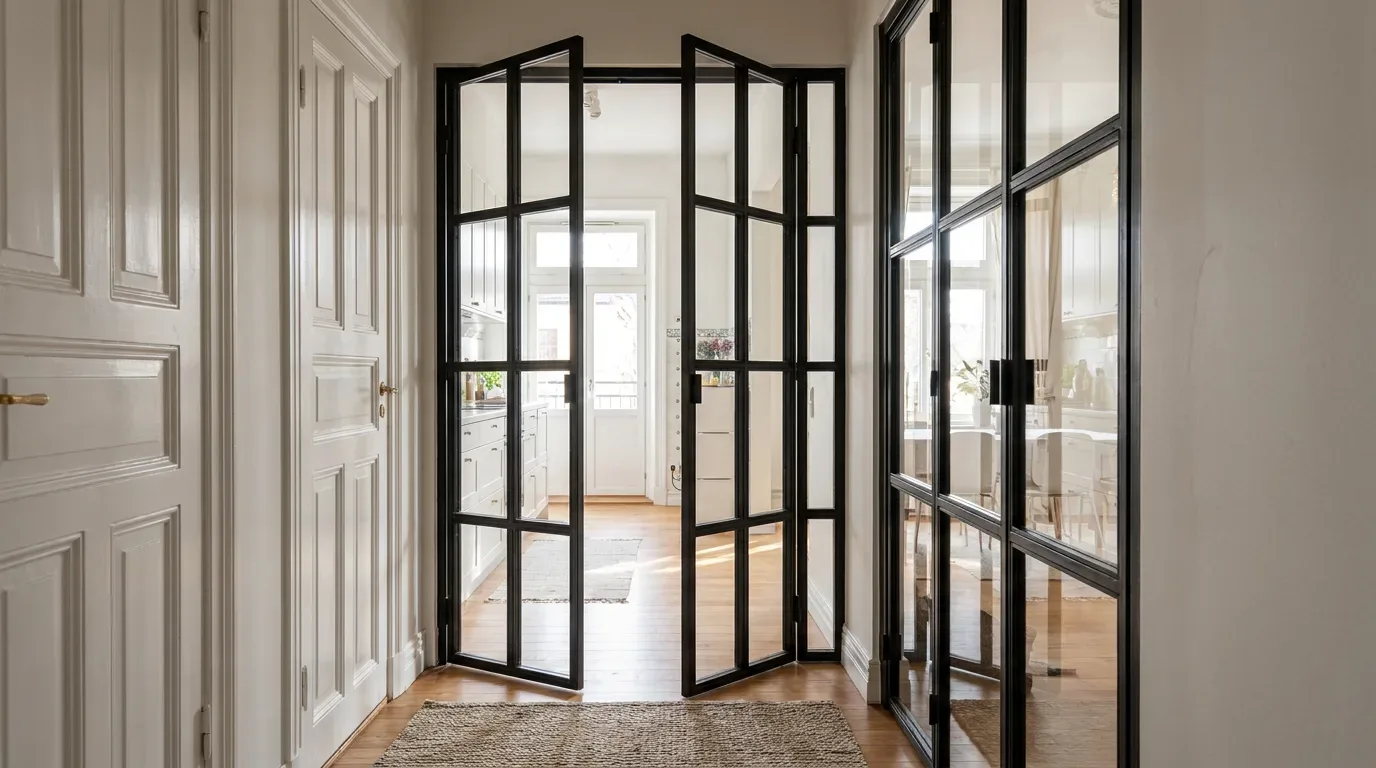
On pivot loft doors - those hung on a central pivot hinge rather than a conventional side hinge - there is no continuous frame rebate for a bolt or mortise lock to catch against. The magnetic catch is often the only technically viable closure in this configuration. For wider pivot panels, a common solution is to combine flush bolts top and bottom (anchoring the panel into the floor and lintel) with a magnetic catch that handles everyday closing. The flush bolts provide structural anchoring; the magnetic catch handles day-to-day use.
Keyed Lock: When Access Control Is Required
A cylinder lock becomes necessary as soon as controlled access matters. Home offices used for professional purposes are a good example: in several European countries, tax authorities require that a dedicated workspace can be physically locked - a slide bolt that can be pushed open from the other side with a credit card does not meet this standard. The choice at that point comes down to two lock types: a mortise lock (recessed into a pocket machined into the steel profile) or a rim lock (surface-mounted on the profile face). Which option is possible depends entirely on profile depth - covered in detail in the installation section below.
A practical illustration: a period-building conversion with 28 mm profiles could not accommodate a mortise lock. The solution was a rim lock combined with a knob cylinder, surface-mounted on the frame - fully functional, and visually consistent with the industrial aesthetic of the door. The lesson is straightforward: profile depth is not a cosmetic detail, it is a hardware decision that needs to be made before production starts.
Multi-Point Locking: When Door Sealing Matters
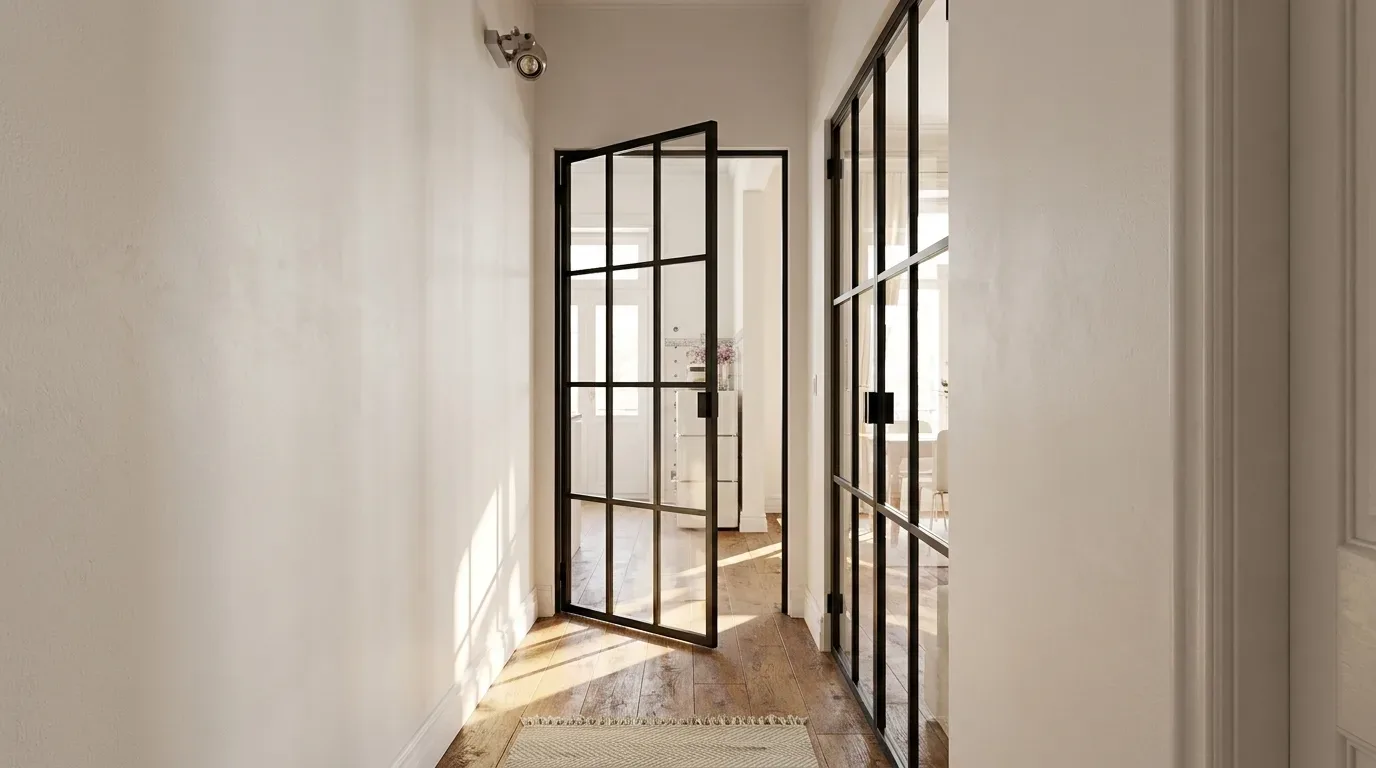
A single bolt or magnetic catch presses the door panel against the frame at one point only. If you are separating a bedroom or studio space and need the door panel pressed evenly against a continuous perimeter seal - for example a compression gasket running around the full frame rebate - a single-point closure is not enough. A multi-point lock with two bolt rods above and below the main lock distributes clamping pressure evenly across the full door height.
The numbers from one studio conversion project illustrate the point clearly: a loft door with VSG safety glass and multi-point locking achieved its target acoustic performance only in combination with the perimeter seal. Without the seal, the result fell 6 to 8 dB short of the target - despite the multi-point lock being correctly installed. Closure system and sealing system must be specified together from the start. Adding a perimeter seal to an already-installed frame is technically demanding and often not feasible without removing the frame.
Loft Door Handle Options: Pull Bar, D-Handle, and Escutcheon Set
Pull Bar: Proportions and Ceiling Height
The long pull bar is the most frequently chosen handle format for loft doors in an industrial aesthetic. Available in lengths from 300 mm up to floor-to-ceiling runs of 1,000 to 2,000 mm, pull bars attach to the steel frame only - never to the glass. From our production experience, the most common ordering mistake is choosing a bar length without cross-checking the centre-to-centre fixing distance against the pre-drilled holes in the frame.
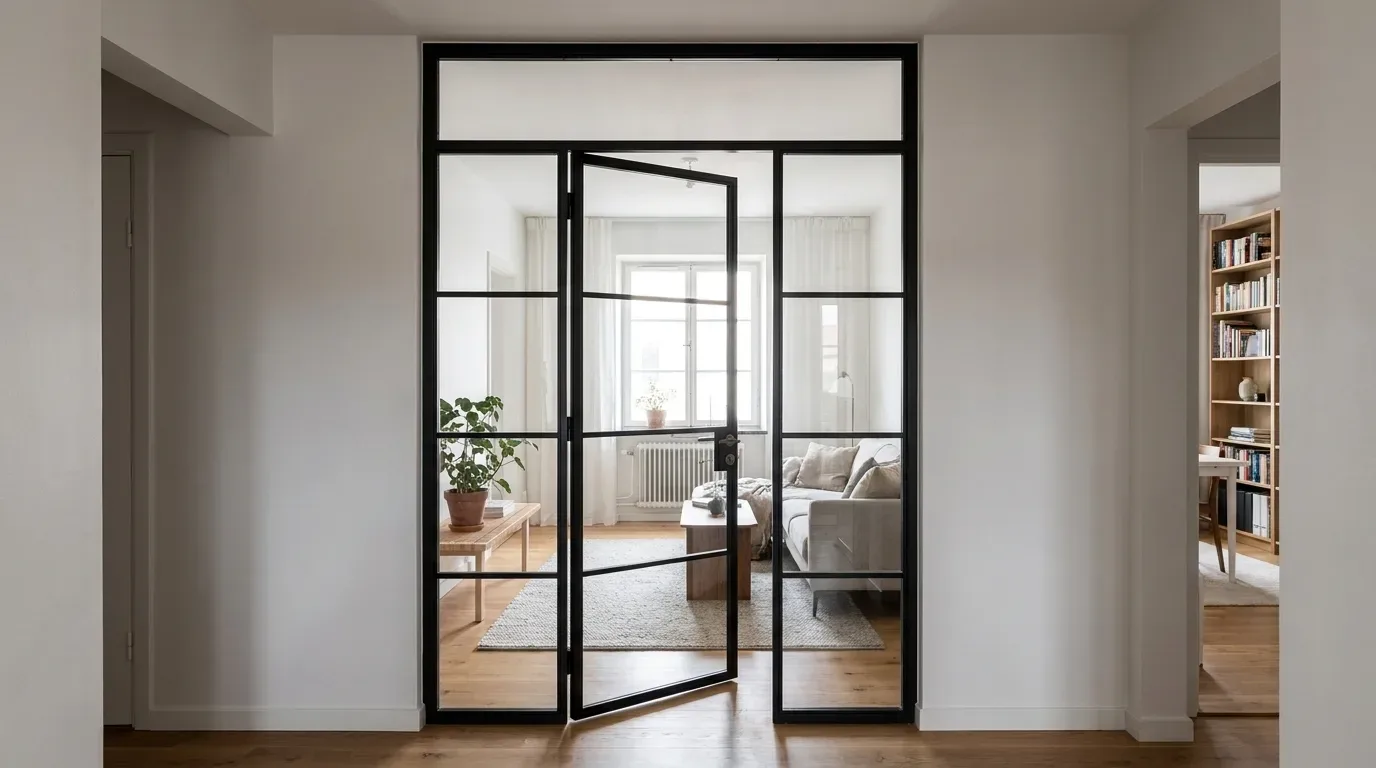
Handle proportions matter more than most buyers expect. In rooms with ceiling heights above 3 m - common in period apartments across Europe, where original ceiling heights of 3.2 m to 3.6 m are standard - a pull bar under 400 mm looks visually out of place and interrupts the vertical line of the frame. Bars from 600 mm upward create a deliberate design statement. Floor-to-ceiling pulls work best on doors 2,400 mm tall or higher. A consistent approach used across multiple loft doors in a single apartment: matching 600 mm pull bars in RAL 9005, no keyed lock, magnetic catch rated at 8 kg - a clean balance between visual calm and reliable closure without rattling.
Pull bars are fixed via two or more threaded holes in the steel profile. The centre-to-centre distance between fixing points must be confirmed before ordering - standard spacings are 300 mm, 400 mm, and 500 mm. A bar with a 400 mm fixing centre cannot be mounted on a frame drilled for 300 mm without an adapter or custom fabrication. Powder-coated steel pull bars are available in the 300 to 600 mm range; floor-to-ceiling versions typically run higher.
D-Handle: Frame-Mounted, No Glass Drilling Required
The D-handle - sometimes called a bow handle or crescent pull - mounts directly onto the steel frame and requires no hole through the glass panel. For loft doors with glazed inserts, this is a significant practical advantage that often gets overlooked at the planning stage. Toughened safety glass (ESG) has a minimum flexural tensile strength of 120 N/mm² after the tempering process. Any attempt to drill through tempered glass after production will release the internal stress instantly and shatter the pane completely. This means the D-handle is the only grip format that can be added to a glazed loft door after installation without requiring a glass replacement.
D-handles are available in several finishes: powder-coated black steel, polished or brushed stainless steel, and burnished brass. An oak-panelled loft door with a burnished brass D-handle and a concealed slide bolt, for example, shifts the same steel frame concept from industrial to residential without changing the frame itself - a useful option if your interior leans warmer than the standard black-on-black palette.
Escutcheon Set: Handle and Cylinder in One Unit
An escutcheon set - a long backplate combining lever handle, rose, and lock cylinder in one continuous shield - minimises the number of visible fixing points on the frame face. For narrow steel profiles where space is limited, it is often the only way to integrate all hardware functions without the frame looking overcrowded. For loft doors used as room dividers with access from both sides, a through-door escutcheon set carries a lever handle on each face and allows the door to be opened from either direction without a second separately mounted handle.
The standard PZ distance between lever spindle and cylinder centre is 72 mm - this must be matched to the lock body you select. Escutcheon sets in the design segment (matt black, from manufacturers such as Griffwerk, FSB, or Hoppe) are available from specialist suppliers.
Ergonomics and Weight: What Changes on Heavy Panels
A handle diameter of 30 to 40 mm sits considerably more comfortably in an adult hand than a flat bar under 15 mm thick - particularly on heavy loft door panels where some force is needed to move the door. On panels above 80 kg, the handle's own weight becomes relevant: a solid steel floor-to-ceiling pull bar can weigh 600 to 1,200 g depending on diameter and length, adding load to the hinges. Checking the manufacturer's weight specification before ordering is not a formality when your panel is close to the 80 kg threshold.
Steel Frame and Installation: What the Profile Determines
Measuring Centre-to-Centre Distance: Total Length Is Not the Fixing Span
The single most common hardware ordering error is confusing the overall length of a pull bar with the centre-to-centre distance between its fixing points. A 600 mm pull bar may have a fixing centre of 300 mm, 400 mm, or 500 mm depending on the manufacturer - these three measurements are not interchangeable. Ordering the wrong centre distance means the bar cannot be mounted, because the threaded holes in the steel frame do not align with the bar's fixing points. The result is a return shipment, a replacement order, and a delay.
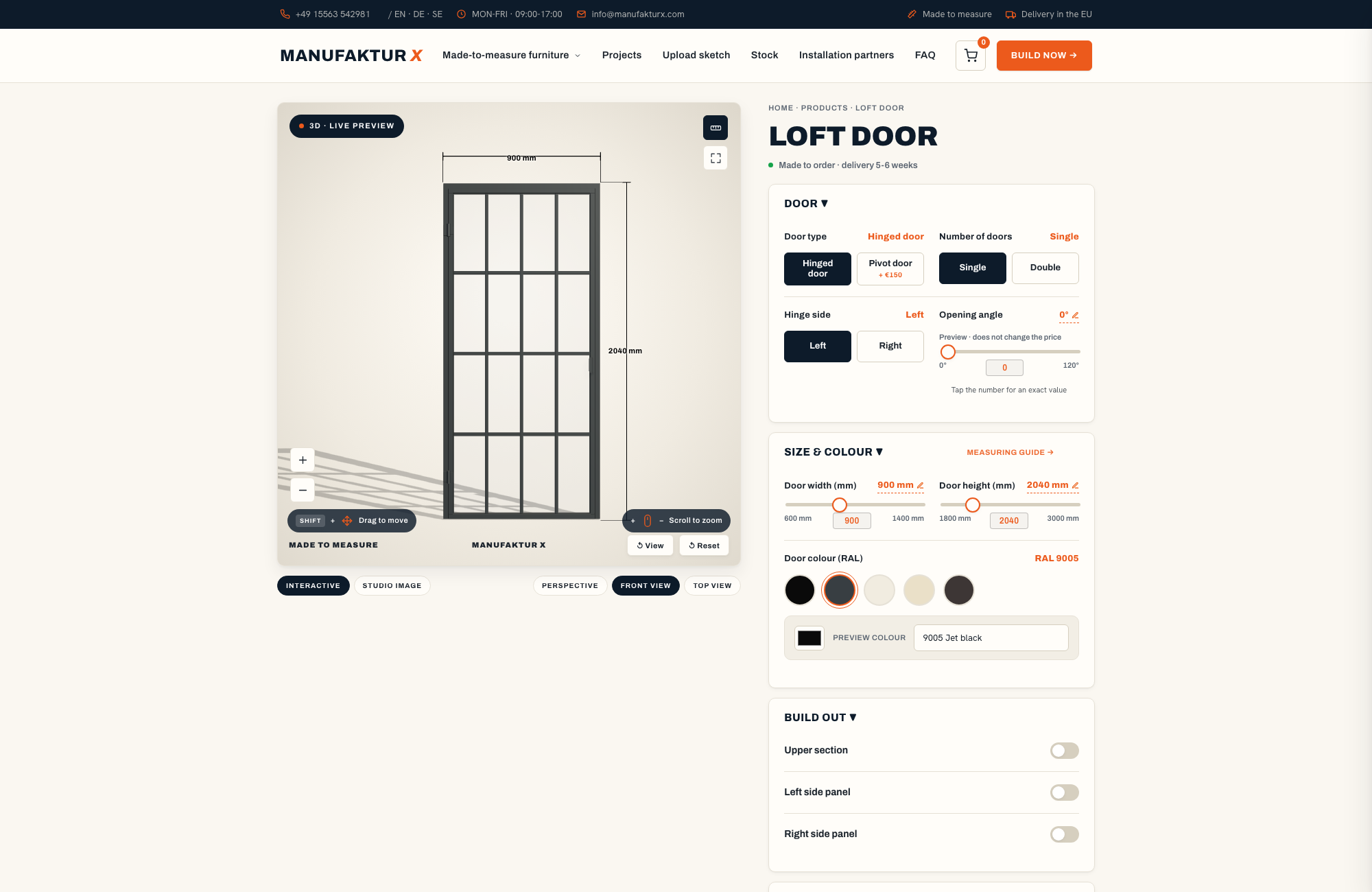
Measure the centre-to-centre distance of your existing frame holes using a calliper - from hole centre to hole centre, not from edge to edge. If you are ordering a new door from Manufaktur X and the holes have not yet been drilled, specify the required centre distance in writing during configuration. The threaded holes are machined into the frame during production. Once manufacturing has started, their positions cannot be changed - and production takes 5 to 6 weeks.
Profile Depth and the Lock Pocket: What Is Structurally Possible
Whether a mortise lock can be fitted to your steel frame comes down to one measurement: the profile depth at the planned lock position. A standard mortise lock requires a milled pocket depth of at least 35 to 40 mm. Security class 3 also requires a bolt throw of at least 14 mm, which is not achievable in profiles shallower than 40 mm. In our production experience, this is the constraint that most often surprises buyers who have already selected their preferred lock before checking the frame specification.
If the profile depth is below 35 mm, a mortise lock is ruled out. The alternative is a rim lock, surface-mounted on the profile face. It is visible, but functionally equivalent - and on slender steel profiles in a loft or industrial interior, it is a widely used and accepted solution. Every additional hole drilled in a steel profile affects the cross-section, which is why hardware positions need to be built into the frame design from the beginning, not treated as an afterthought.
Safety Glass: All Holes Must Be Made Before Tempering
ESG toughened safety glass has a minimum flexural tensile strength of 120 N/mm² - compared with around 45 N/mm² for standard float glass. This internal stress is the product of the thermal tempering process and is what makes ESG impact-resistant. It also makes any post-production drilling impossible: a cut or bore introduced after tempering releases the stored stress instantly and destroys the pane. All holes for handles, fittings, or fixings must therefore be drilled before the glass enters the tempering oven.
The same principle applies to VSG laminated safety glass. A typical 2 x 4 mm VSG construction has a total thickness of 8.76 mm including the 0.76 mm PVB interlayer - and any holes must be planned before lamination. The practical consequence for handle mounting is clear: all handles on glazed loft doors must be fixed to the steel frame, not to the glass. If you need glass-mounted fixings for a specific design reason, these must be flagged during the configuration process so that the holes are machined into the glass before tempering - not after delivery.
Threaded Holes and Welded Nuts: Planning Ahead Pays Off
Attaching handles, bolts, or escutcheon sets to a steel profile requires either M5 or M6 threaded holes, or welded-in nuts. Both must be incorporated during the manufacturing phase. Tapping threads into a finished, welded steel frame on site is technically possible but difficult - it risks damaging weld seams and costs considerably more in labour than specifying the positions during production. At Manufaktur X, all threaded positions and centre distances are confirmed in the configurator and locked in before production begins. As a direct manufacturer with EU-based production, this information goes straight from your configuration into the workshop with no intermediary - no translation loss, no misread specification sheet.
If you are retrofitting hardware to an existing loft door, measure the wall thickness of the hollow profile at the intended mounting point. Profiles with a wall thickness below 3 mm cannot hold a loaded thread reliably for a frequently used handle. In that case, ask a metalworker to weld in a nut from the inside - the cost per point depends on access and local rates.
Retrofitting a Lock to an Existing Loft Door
What to Check Before You Order Hardware
Adding a keyed lock to an existing loft door is possible in many cases without replacing the whole door - provided the profile depth at the planned lock position is at least 40 mm. If that condition is met, a metalworker can mill the lock pocket and fit a mortise lock, covering materials and labour. Specifying the lock pocket during the original manufacturing phase costs nothing extra and avoids this expenditure entirely.
The decision logic for lock selection by profile depth:
- Profile depth 40 mm or more: standard mortise lock is possible
- Profile depth 35 to 39 mm: mortise lock requires a custom solution; rim lock recommended
- Profile depth below 35 mm: rim lock or magnetic catch only
Knob Cylinder: Cost and Replacement Logic
For residential loft doors, the knob cylinder is the most practical cylinder type: operated by key from the outside and by a thumb turn from the inside - no key needed in the room. Replacement cylinders are available from specialist suppliers at varying prices depending on security rating and brand. When a tenant changes or a key is lost, replacing only the cylinder is sufficient - the lock body and all other hardware stay in place.
If long-term flexibility matters - particularly in rental properties with frequent changes of occupant - choose a lock body with an interchangeable cylinder system. The cylinder can be swapped without tools, which saves time and cost compared with rekeying or replacing the full lock assembly. For home office rooms or storage spaces, security class 3 (minimum bolt throw 14 mm, residential entry-door standard) is generally sufficient.
Electronic Cylinders: NFC and Bluetooth Options
Electronic cylinders from manufacturers such as Assa Abloy or SimonsVoss can be fitted into any standard cylinder housing without modifying the lock body itself. Prices vary depending on the system and connectivity (NFC, Bluetooth, app control). The practical advantages over a mechanical cylinder are keyless entry and logged access - relevant for shared home office spaces or professional rooms with multiple users.
The trade-off is battery dependence: typical battery life is 1 to 2 years. If you want a fallback for flat batteries, choose a system with a mechanical emergency key override - both Assa Abloy Aperio and SimonsVoss MobileKey include this as standard.
Magnetic Catch as a Middle Ground: Room Dividers Without Keys
Where the goal is not security but simply keeping the door reliably in the closed position, the magnetic catch remains the most elegant solution. No visible mechanism, no rattling, no key management. For open-plan apartments where loft doors serve as soft dividers between living zones - accessible from both sides, pulled shut rather than locked - a correctly rated magnetic catch is a functionally complete answer. The key word is correctly rated: match the holding force to the actual panel weight, not to the lightest specification available. A 3 kg catch on a 70 kg panel will not hold against a window draught.
Ready to configure your loft door with the right hardware from the start? The Manufaktur X 3D configurator lets you select closure type, handle format, and glass type in real time - with instant pricing and a visual preview of exactly what you are ordering before production begins.
Frequently Asked Questions: Loft Door Hardware
Can I add a handle to a glazed loft door after installation?
Yes, as long as the handle attaches to the steel frame rather than the glass. D-handles and pull bars can be retrofitted to the frame at any point. Any fixing that would require drilling through the tempered glass (ESG) is not possible after production - the glass would shatter. If you need glass-mounted fixings, they must be specified before manufacturing.
What holding force does a magnetic catch need for a heavy loft door?
For door panels weighing 60 kg or more, use a magnetic catch rated at a minimum of 8 kg holding force. Catches rated below 8 kg are not reliable for full-size loft door panels in everyday use - draughts from open windows create enough pressure to pull a lighter catch open.
Is a mortise lock always possible in a steel loft door frame?
No. A mortise lock requires a minimum profile depth of 35 to 40 mm at the lock position. Slimmer profiles cannot accommodate the lock pocket. In that case, a surface-mounted rim lock is the correct alternative - it is functionally equivalent and widely used on slender industrial-style steel frames.
How do I measure the correct centre distance for a pull bar?
Measure from the centre of one fixing hole to the centre of the other using a calliper - not from edge to edge, and not from the ends of the bar. Standard centre distances are 300 mm, 400 mm, and 500 mm. A bar drilled for 400 mm cannot be mounted on a frame drilled for 300 mm without an adapter. Always confirm the centre distance before ordering.
Can I specify hardware positions when ordering a new loft door?
Yes, and it is strongly recommended. When you configure a loft door through Manufaktur X, you specify handle centre distances, lock pocket requirements, and any glass holes during the configuration step. These positions are machined into the frame and glass during production. Changes after manufacturing has started are not possible within the 5 to 6 week production window.