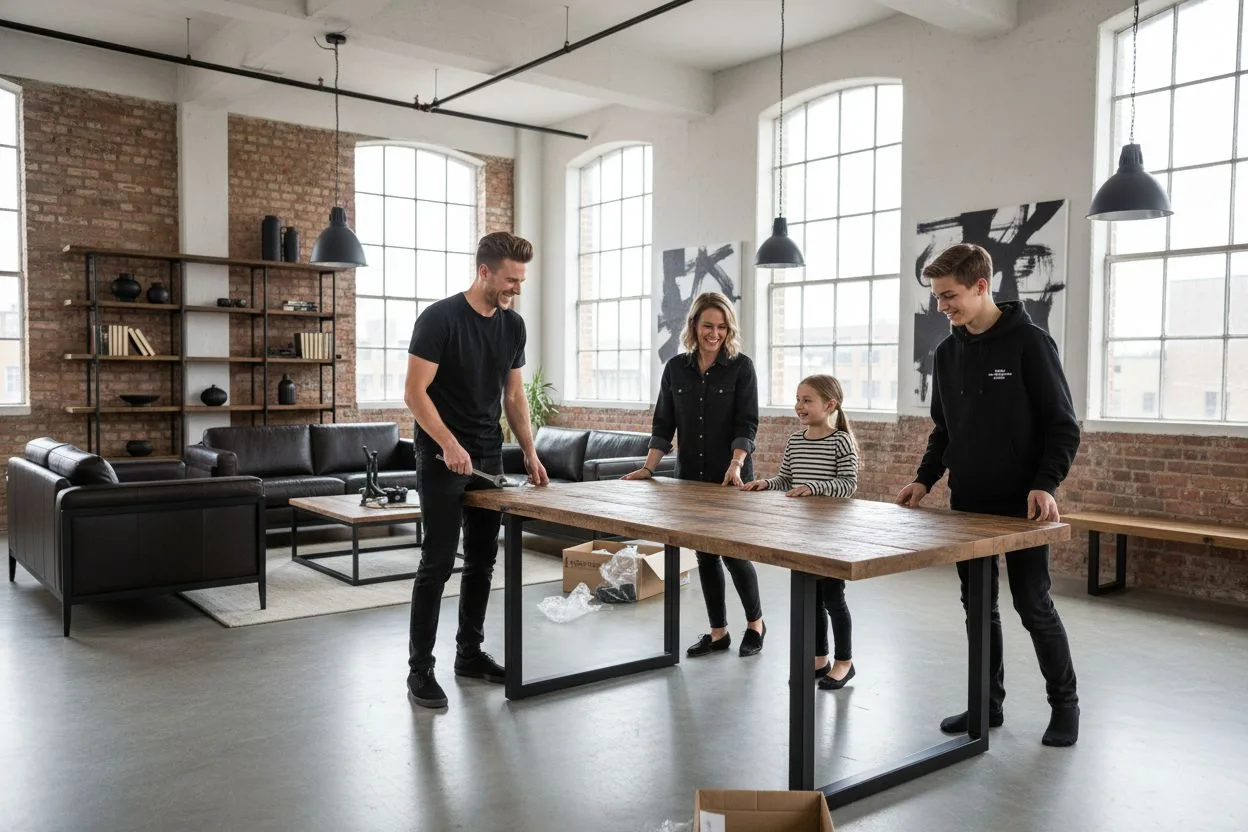
There is a particular satisfaction that comes from a room where everything fits - not approximately, not after filling gaps with trim strips, but exactly. If you have ever lived with furniture that was truly made for your space, you understand immediately why custom matters. Manufaktur X builds individual pieces in steel, solid wood and glass, each produced to the precise dimensions you enter - no standard sizes, no compromise.
What Is the Industrial Style - and Why Does Custom Make the Difference?
The industrial aesthetic draws on the visual language of former factories and warehouses: raw materials left visible, structural elements treated as design features, a palette that runs from anthracite to rust brown. What makes this style compelling is its honesty - nothing is hidden. Weld seams, bolts, wood grain, the cold surface of steel next to the warmth of oak: all of it is intentional.
When European warehouses and industrial buildings were converted into residential lofts during the 1970s and 1980s, the first occupants worked with what was already there - heavy wooden tables, metal shelving, robust utilitarian objects. A new domestic aesthetic emerged from that necessity, and it has proved remarkably durable. Today the style appears in everything from Scandinavian new-builds to century-old Parisian apartments, precisely because its principles - authenticity, function, material honesty - are not trend-dependent.
Custom manufacturing matters here more than in almost any other style. An industrial loft door that does not sit flush, or a steel-framed shelf that leaves an awkward gap against an uneven wall, undermines the entire aesthetic. The rawness of the style amplifies imprecision rather than hiding it.
The Core Principles of Industrial Design in the Home
- Material authenticity: Steel, solid wood, glass and concrete - shown as they are, not concealed behind cladding
- Structural honesty: Joints, bolts and frames are part of the visual language, not defects to be covered
- Form follows function: Every element justifies its presence through practical purpose
- Patina as character: Use marks are not wear - they are the beginning of a piece's history
- A restrained palette: Greys, blacks, rust tones and earthy browns; colour as accent rather than statement
| Characteristic | Its role in the industrial style |
|---|---|
| Material character | Steel, solid wood, glass - natural structure kept visible |
| Structural openness | Visible joints, bolts and frames as deliberate design elements |
| Colour palette | Grey, anthracite, rust, black, earth tones - emphasising authenticity |
| Surface treatment | Minimal processing, natural patina, raw aesthetic |
| Functional aesthetic | Every element has a clear purpose; decorative excess is avoided |
Variations on the Theme
The industrial style is not monolithic. Depending on your space and how much rawness you want to live with, several sub-styles are worth considering:
- Classic Industrial: Maximum rawness - exposed brick, heavy steel beams, original factory elements
- Modern Industrial: Clean lines and a restrained interpretation, suited to new-build apartments
- Urban Loft: Softer shapes, light surfaces and textile accents that take the edge off the harder materials
- Rustic Industrial: Heavy emphasis on reclaimed wood and aged materials
- Industrial-Scandi: The warmth of Nordic design tempers the severity of industrial materials - a popular combination in Northern Europe
- Industrial-Vintage: Raw finishes paired with nostalgic found objects and period details
Custom Furniture vs. Off-the-Shelf: An Honest Comparison
Retailers such as IKEA offer affordable entry points into the industrial look - the FJÄLLBO and LIXHULT ranges are recognisable examples. They work well in standard spaces with standard requirements. The limitation is precisely that word: standard. When your ceiling runs to 2.9 metres, when your period apartment has walls that are not quite plumb, when you want a loft door at a specific height that no catalogue lists, a standard product becomes a visible compromise.
Custom furniture is sometimes framed as a luxury decision. It is more accurately described as a precision decision. The question is not whether you can afford bespoke - it is whether a standard product will actually do the job you need it to do.
Fit and Individuality
The most common reason custom furniture does not fit is mis-measurement, not a production fault. Standard furniture sidesteps this problem by using standardised openings - but it introduces a different problem: your room has to adapt to the furniture rather than the furniture adapting to your room. A custom loft door that sits to the millimetre looks categorically different from one adjusted with filler strips.
Material Quality and Longevity
Solid hardwood and structural steel outlast particleboard and plastic-laminated surfaces by decades. In the industrial style, this is not just a quality argument - it is an aesthetic one. The patina that develops on solid oak or powder-coated steel over years of use is part of the design. Chipboard simply deteriorates.
Sustainability and Long-term Value
A piece of furniture that lasts thirty years and develops character in the process is a fundamentally different proposition from a flat-pack unit replaced every five to seven years. Choosing custom is a decision against the replacement cycle - fewer resources consumed, less waste generated, and a piece that becomes more interesting over time rather than less.
| Aspect | Custom industrial furniture | Off-the-shelf furniture |
|---|---|---|
| Fit | Exact dimensions to your space | Standardised sizes; gaps or overhangs common |
| Material | Solid hardwood and structural steel | Often particleboard, laminate or MDF |
| Design | Configured to your taste and requirements | Fixed options; limited personalisation |
| Longevity | Decades; develops patina | Short to medium lifespan; not repairable |
| Production | Skilled handcraft with precision machinery | Industrial mass production |
Materials at Manufaktur X: What Goes Into Each Piece
Material choice determines whether a piece of industrial furniture is convincing or merely decorative. At Manufaktur X, the range is deliberately focused: solid wood, powder-coated steel, and - in the steel-and-glass products - safety glass.
Solid Wood: Oak, Beech and Ash
All three species are hardwoods with strong natural grain patterns and proven durability - exactly the properties that the industrial style wants visible rather than concealed. Oak offers particularly pronounced grain and a warm tone. Beech is tighter-grained and takes stain evenly. Ash has a distinctive, sometimes almost graphic figuring. Over 50 different stain finishes are available, from pale natural tones through to deep, dark shades.
In our production, hardness matters practically as well as aesthetically. Oak, beech and ash resist the surface dents and scratches that softer species would accumulate in a working dining table or frequently-used bench. That resistance is built into the material, not applied on top of it.
Steel Frames: Powder Coating in Any RAL Colour
Steel frames at Manufaktur X are finished by powder coating - not painted. The distinction matters. In powder coating, electrostatically charged powder is applied to the steel and then cured in an oven, creating a finish that bonds to the surface at a molecular level. The result is scratch-resistant, colour-consistent across the entire surface, and more environmentally responsible than solvent-based wet paint, since powder coating produces no volatile organic compounds. Anthracite (RAL 7016), black (RAL 9005) and white (RAL 9010) are the most frequently chosen colours, but any RAL shade is available.
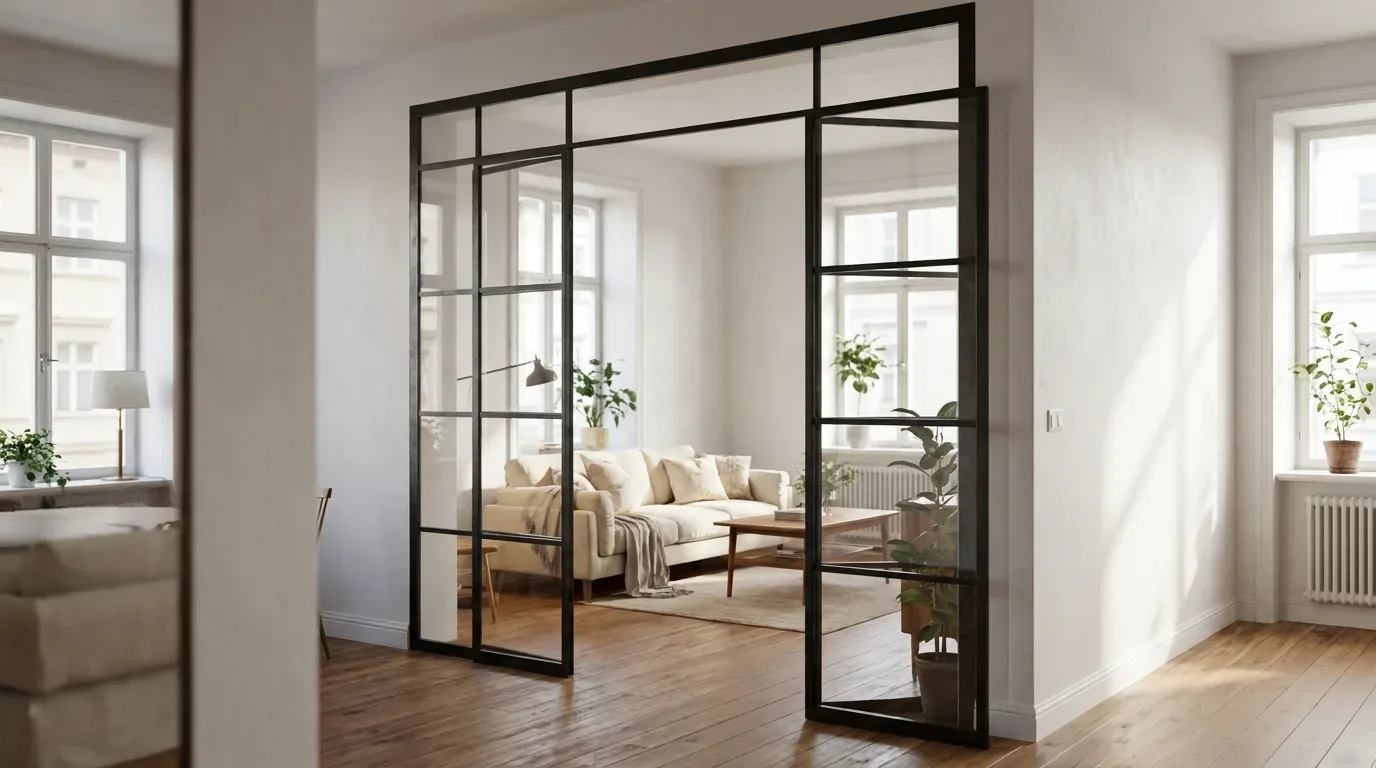
Glass: Five Options for Loft Doors and Room Dividers
Glass is used exclusively in the two steel-and-glass products: the loft door and the room divider. Five glass designs are available in the configurator:
- Clear glass - maximum transparency and light transmission
- Frosted glass - soft privacy while still passing light
- Smoked glass - a tinted appearance with mild visual screening
- Dark smoked glass - stronger tint for greater privacy
- Textured glass - a patterned surface that diffuses light
For glass type, both ESG (toughened single-pane safety glass) and VSG (laminated safety glass) are available. For larger door or divider dimensions, VSG is recommended for additional stability and safety - the two bonded panes hold together if the glass is broken, rather than shattering.
The Manufaktur X Product Range
Every product is made to order in the EU. The range divides into steel-and-glass pieces and steel-and-solid-wood pieces.
Loft Door - a Real Steel-and-Glass Door to Your Dimensions
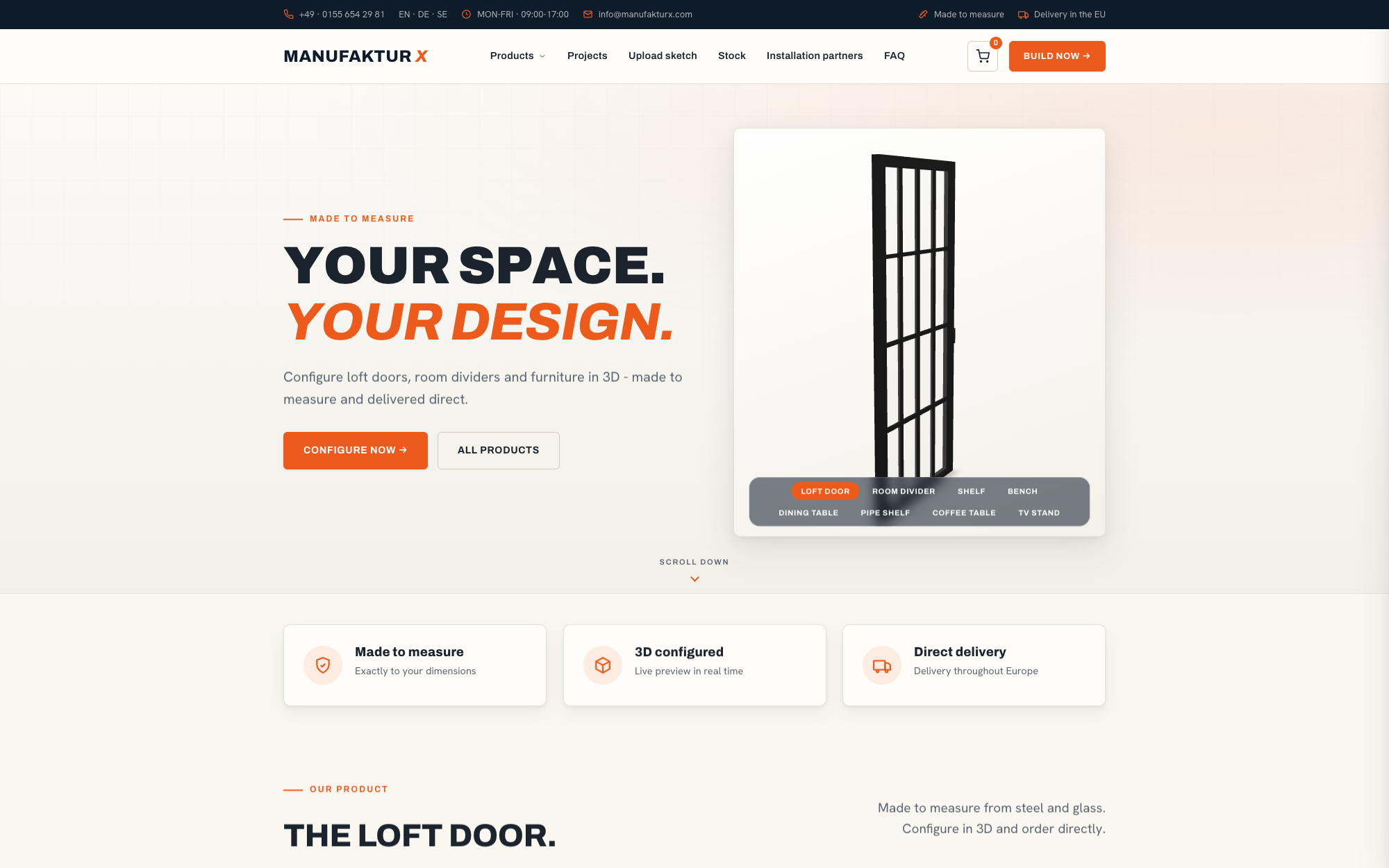
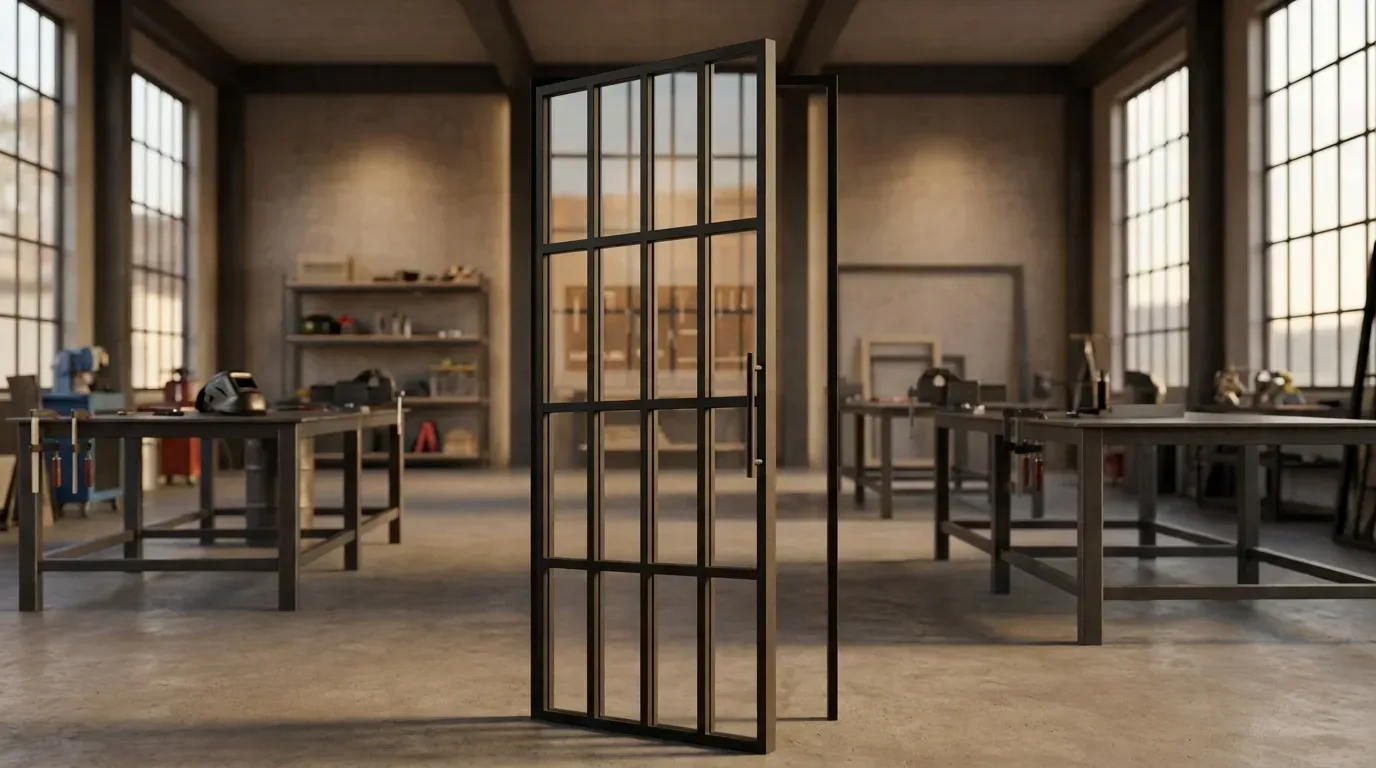
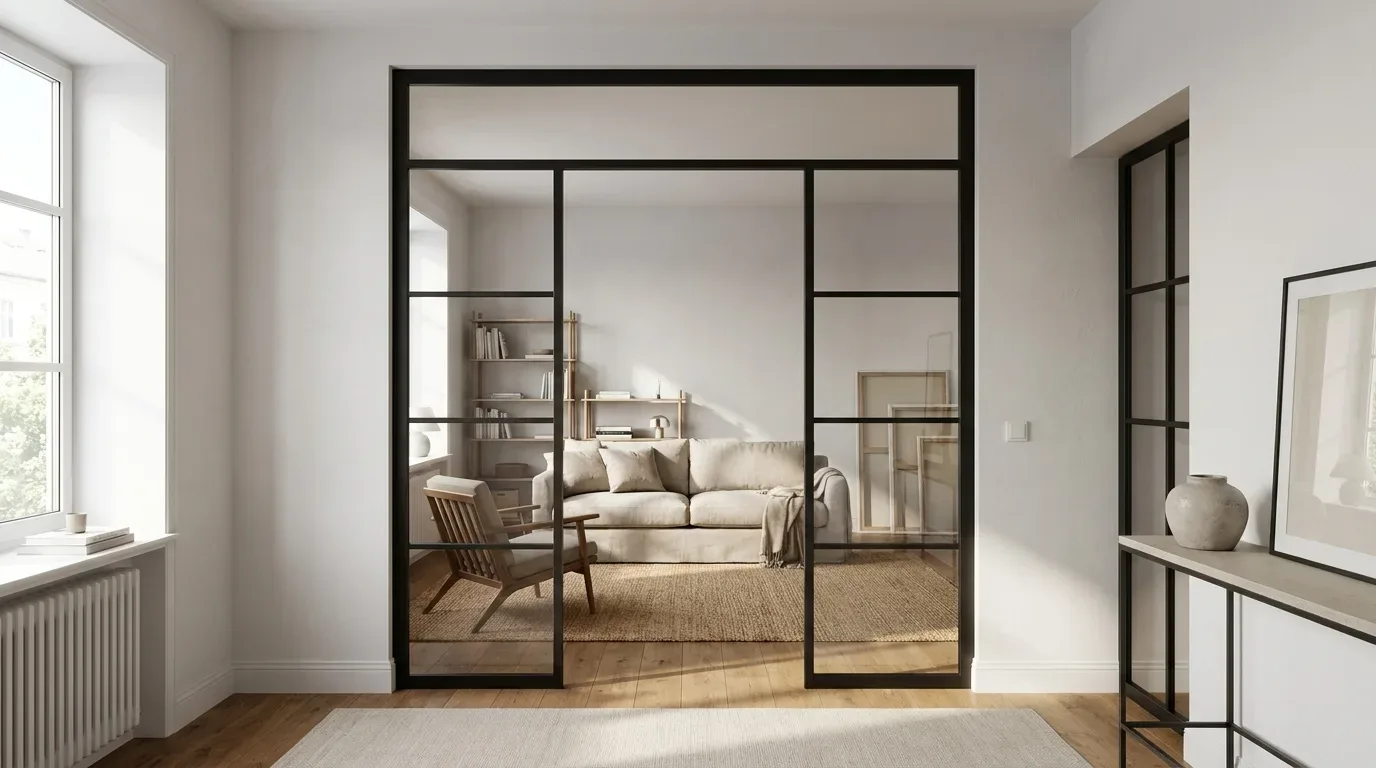
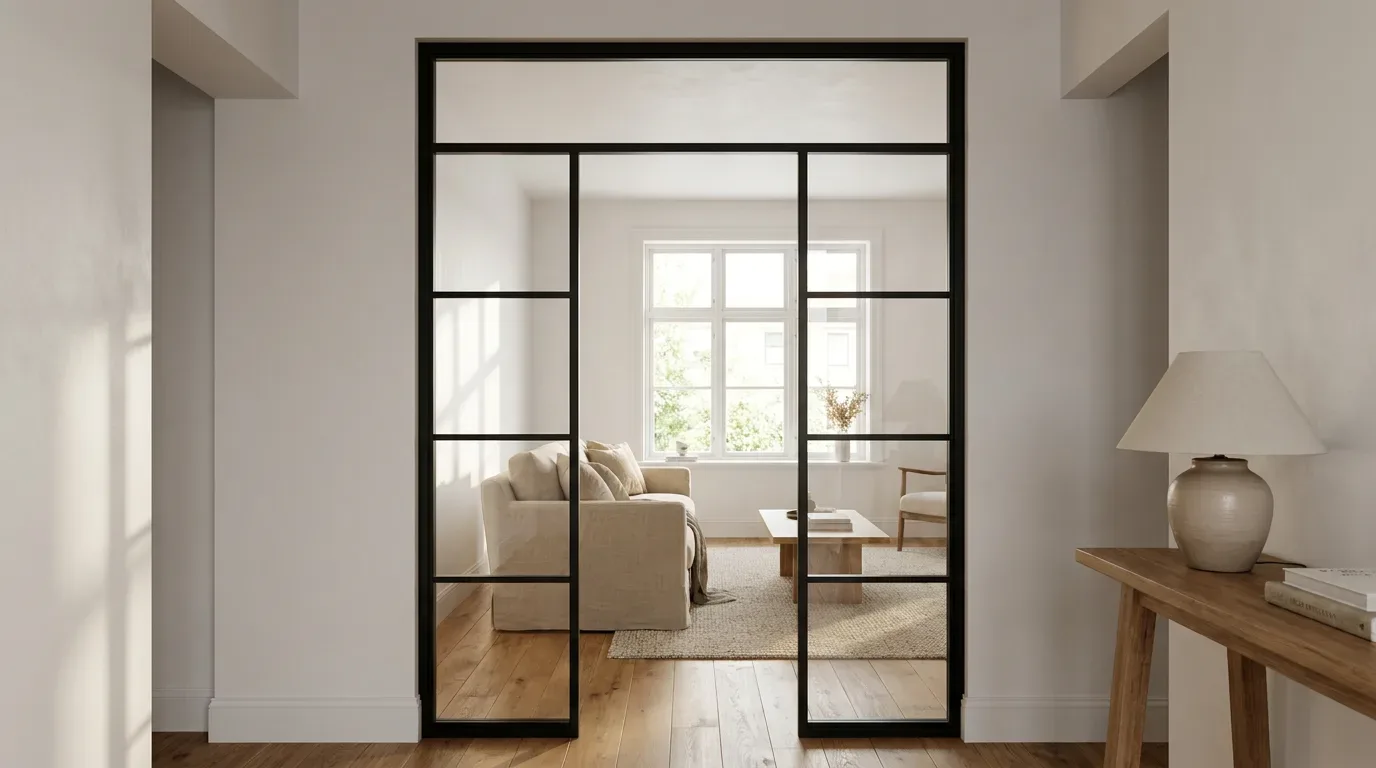
The Manufaktur X loft door is a functioning door with a door stop (left or right hinge side, your choice), a configurable opening direction and opening angle, and hinges. Three handle designs are available: Long, Subtle and Half-moon. Slender steel profiles, generous glass panels, a clear factory aesthetic - starting from €1,157 for the most basic configuration.
Room Divider - a Fixed Steel-and-Glass Partition
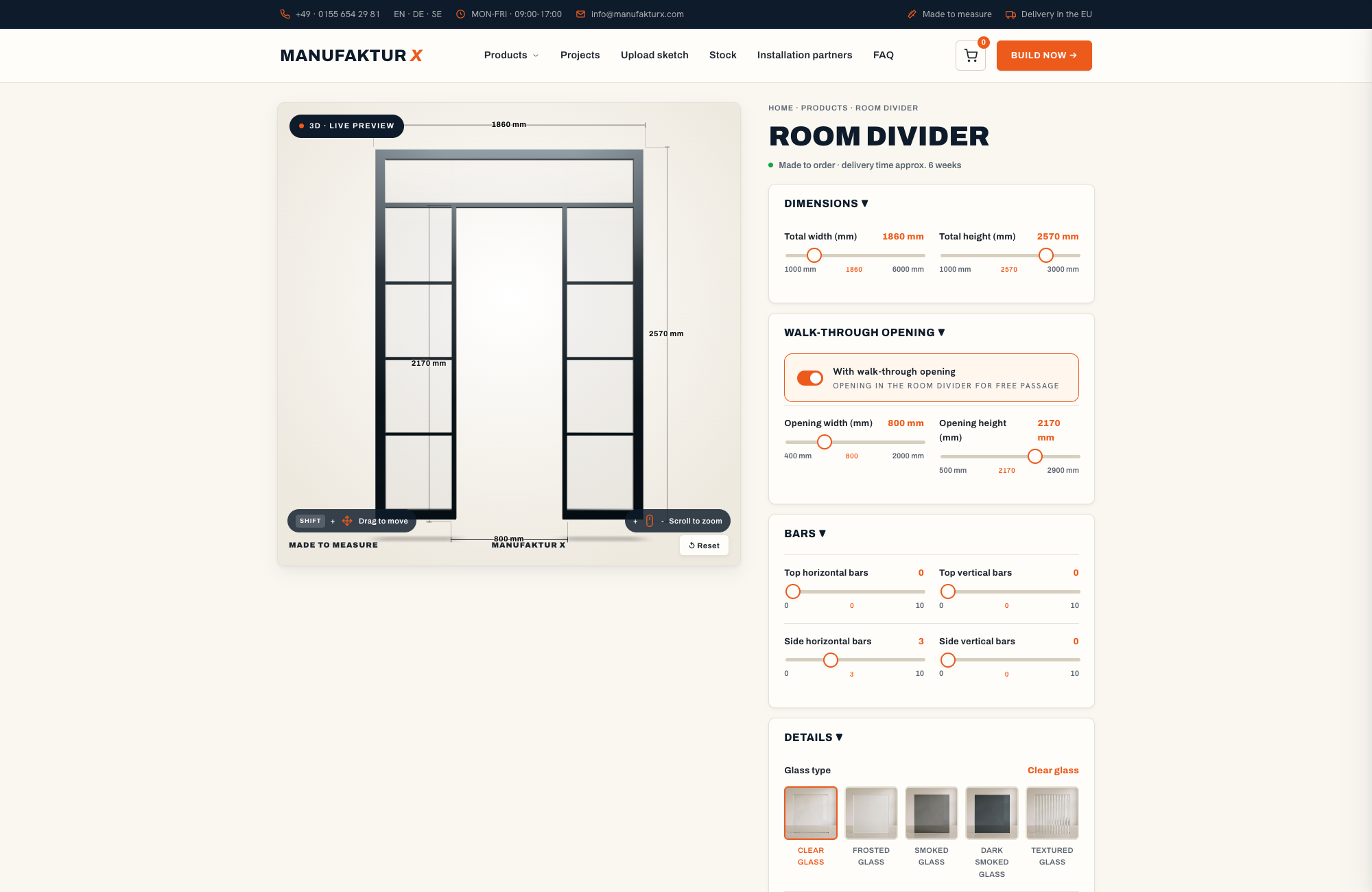
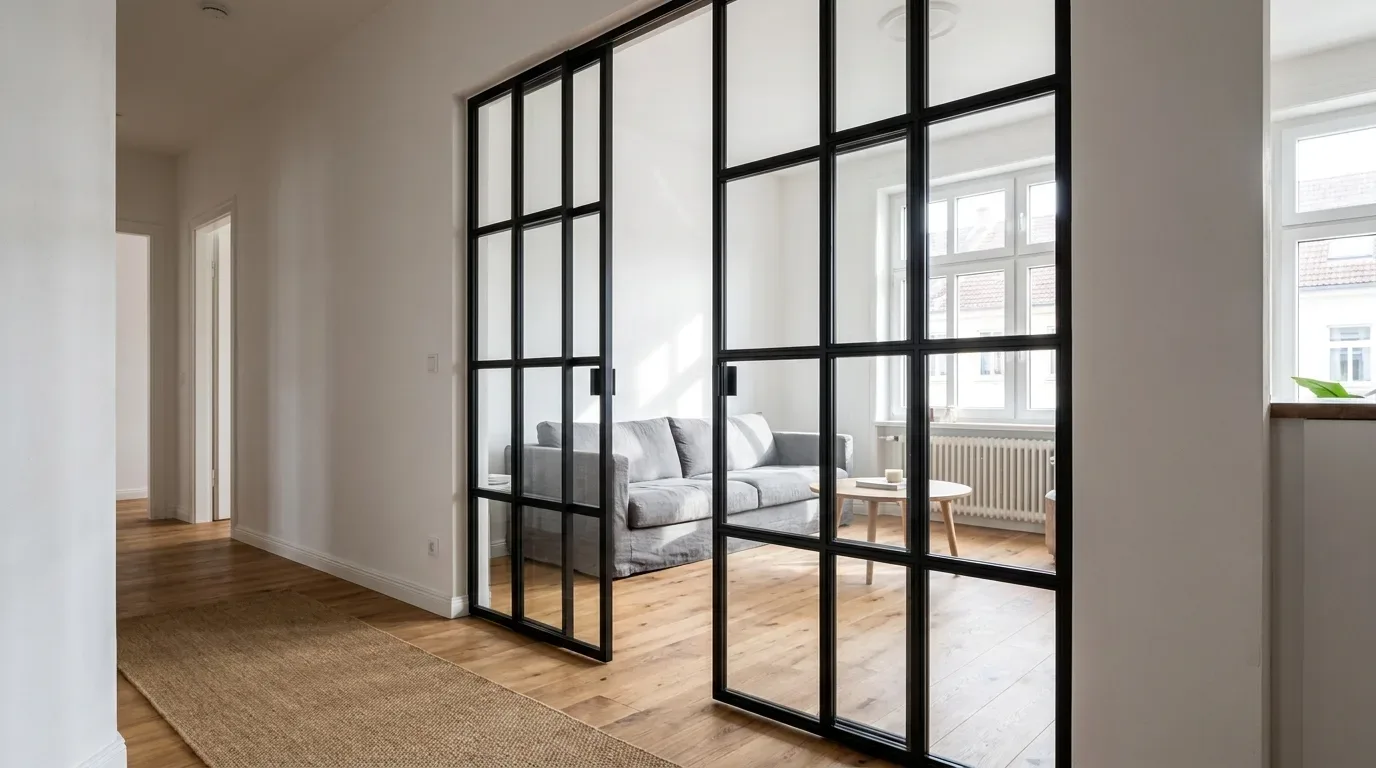
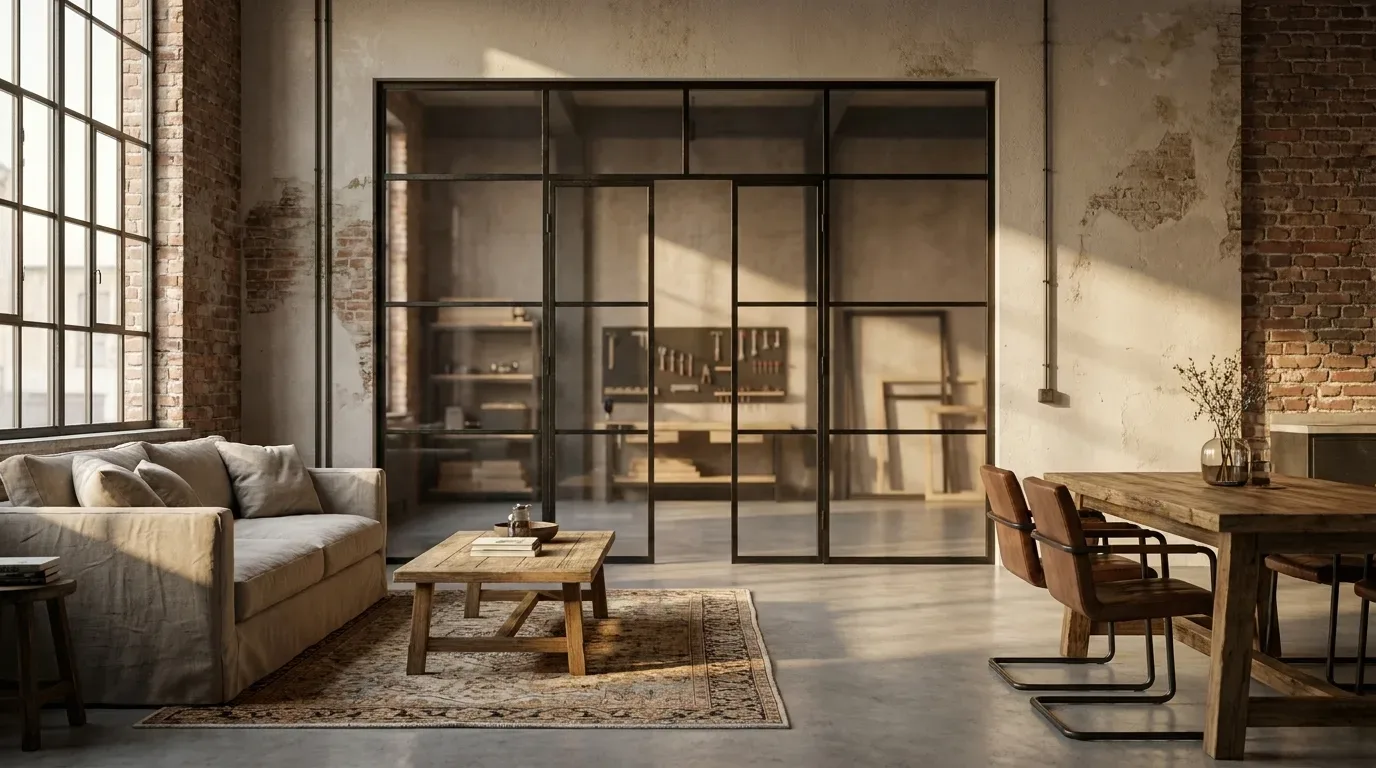
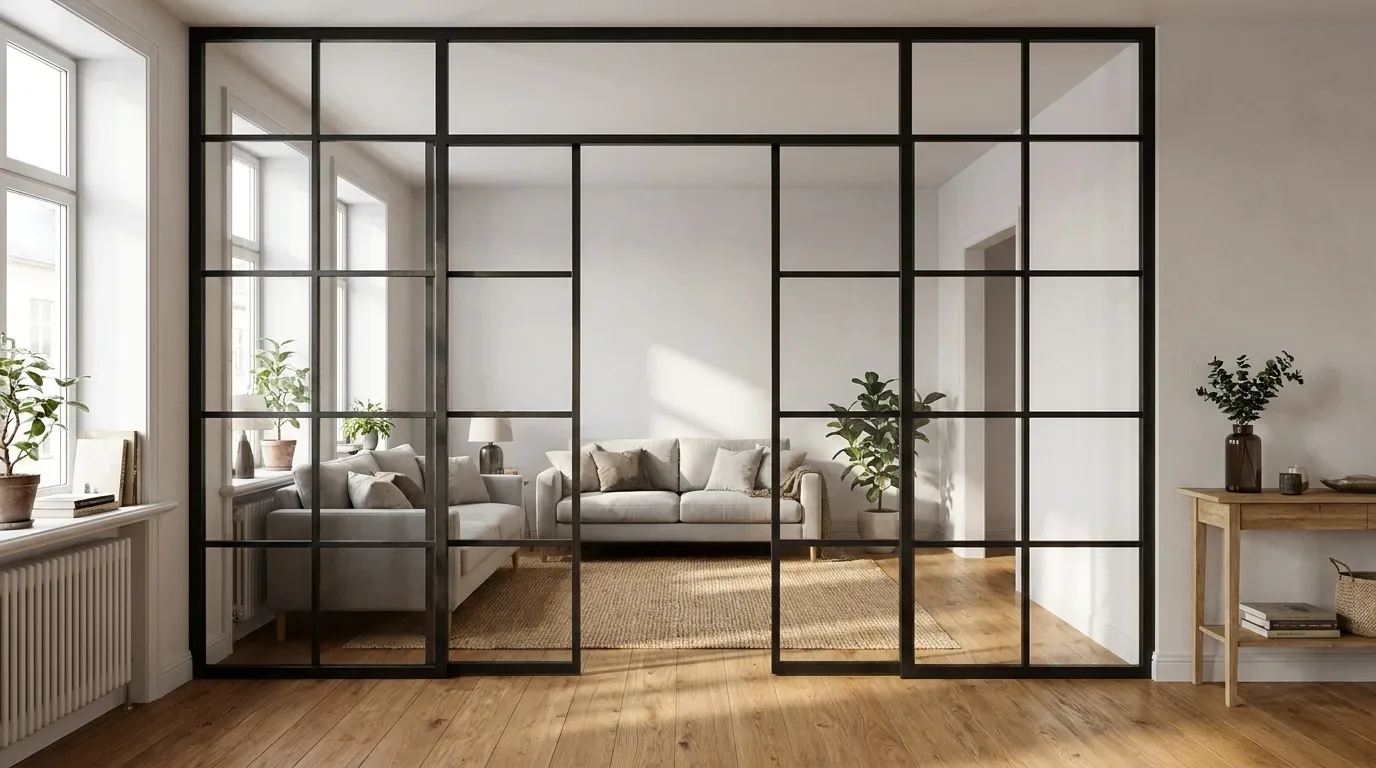
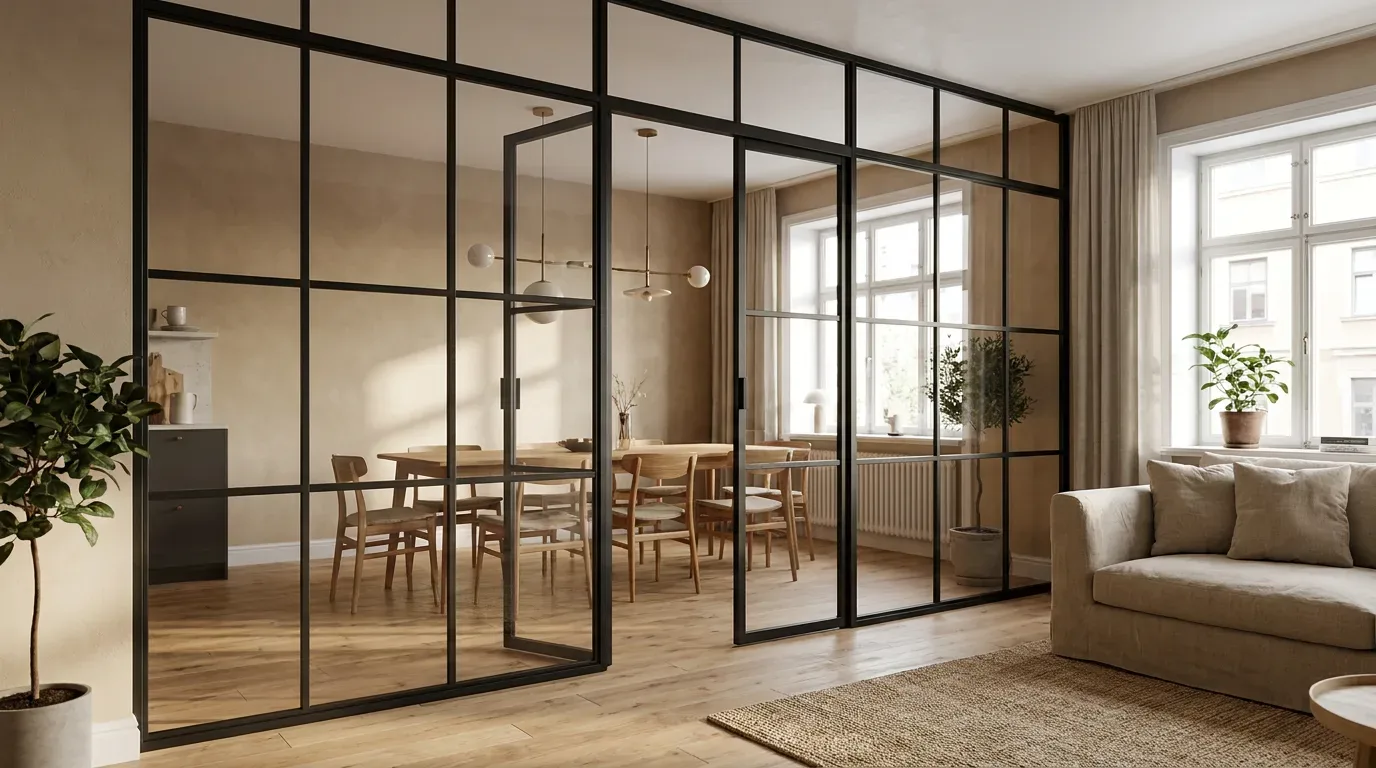
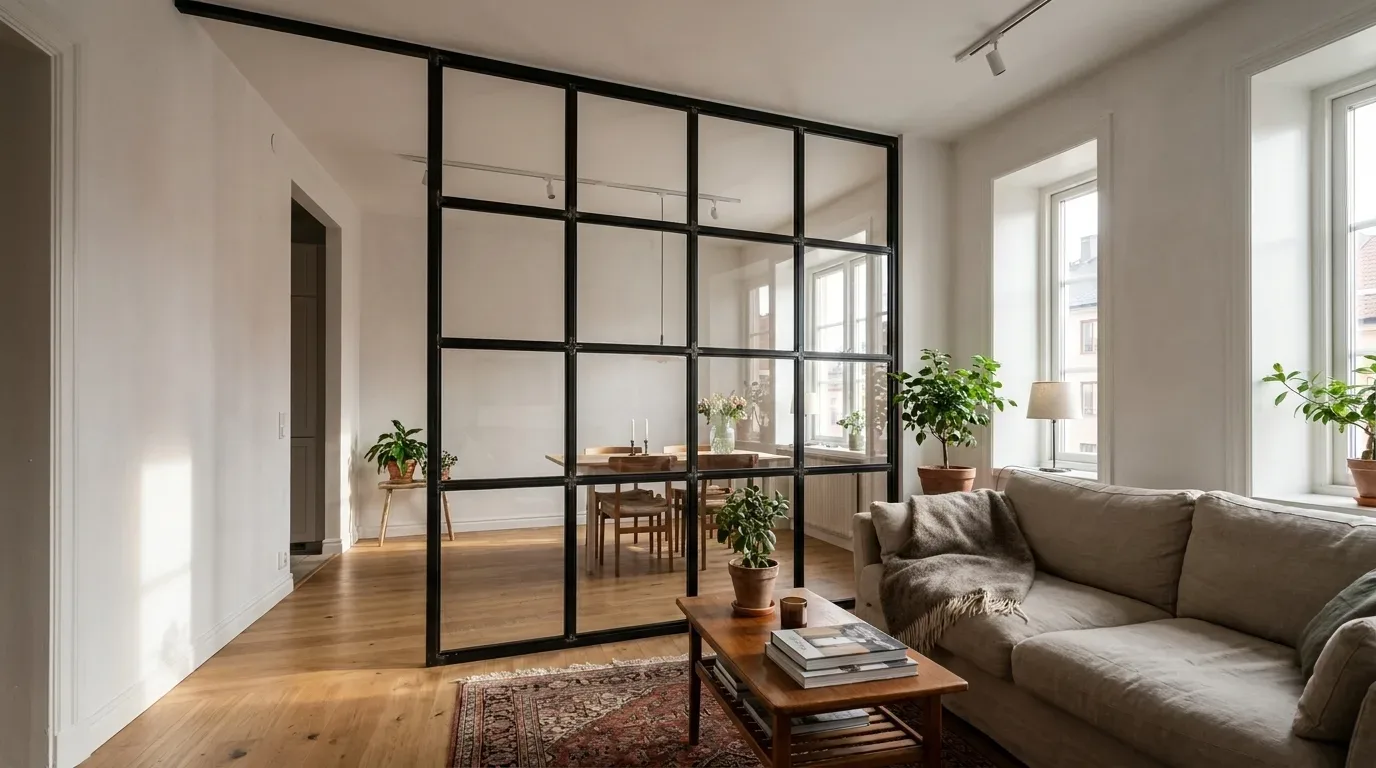
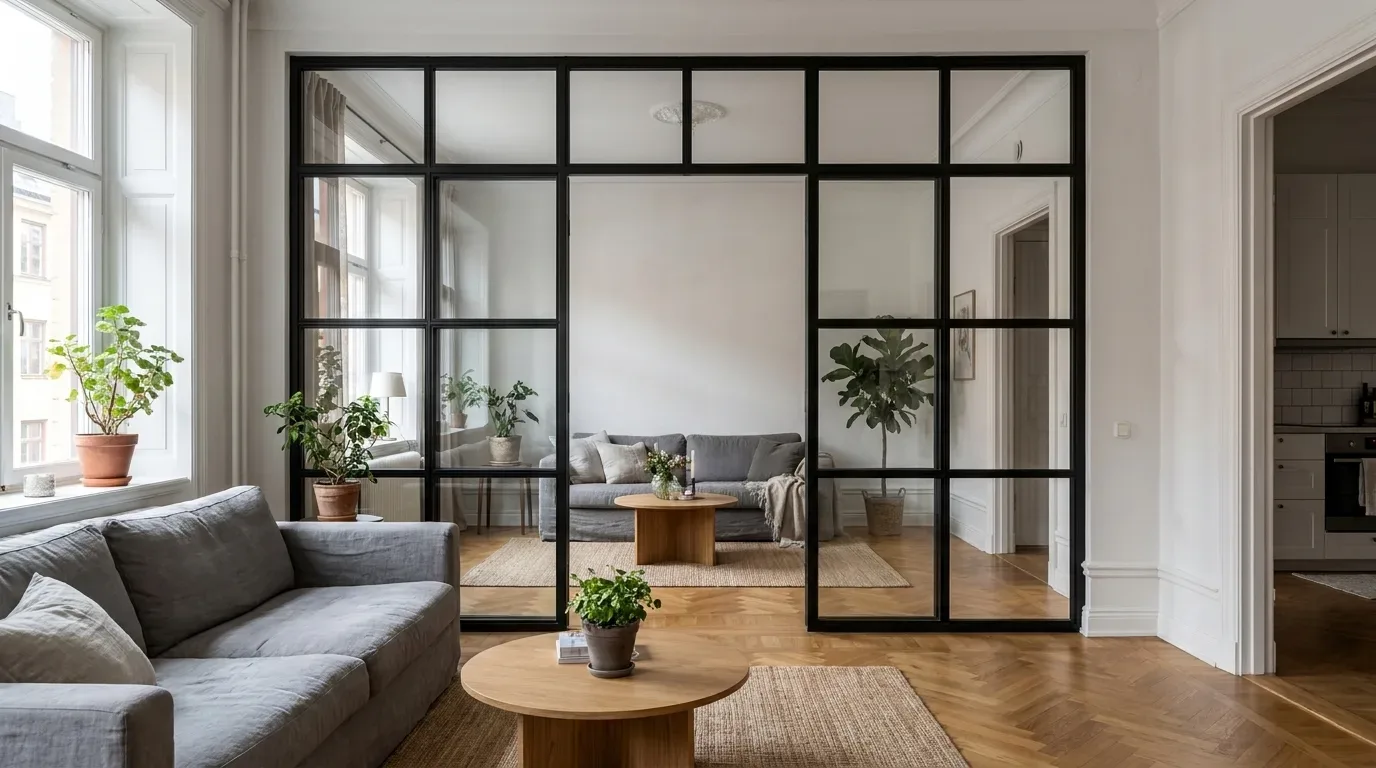
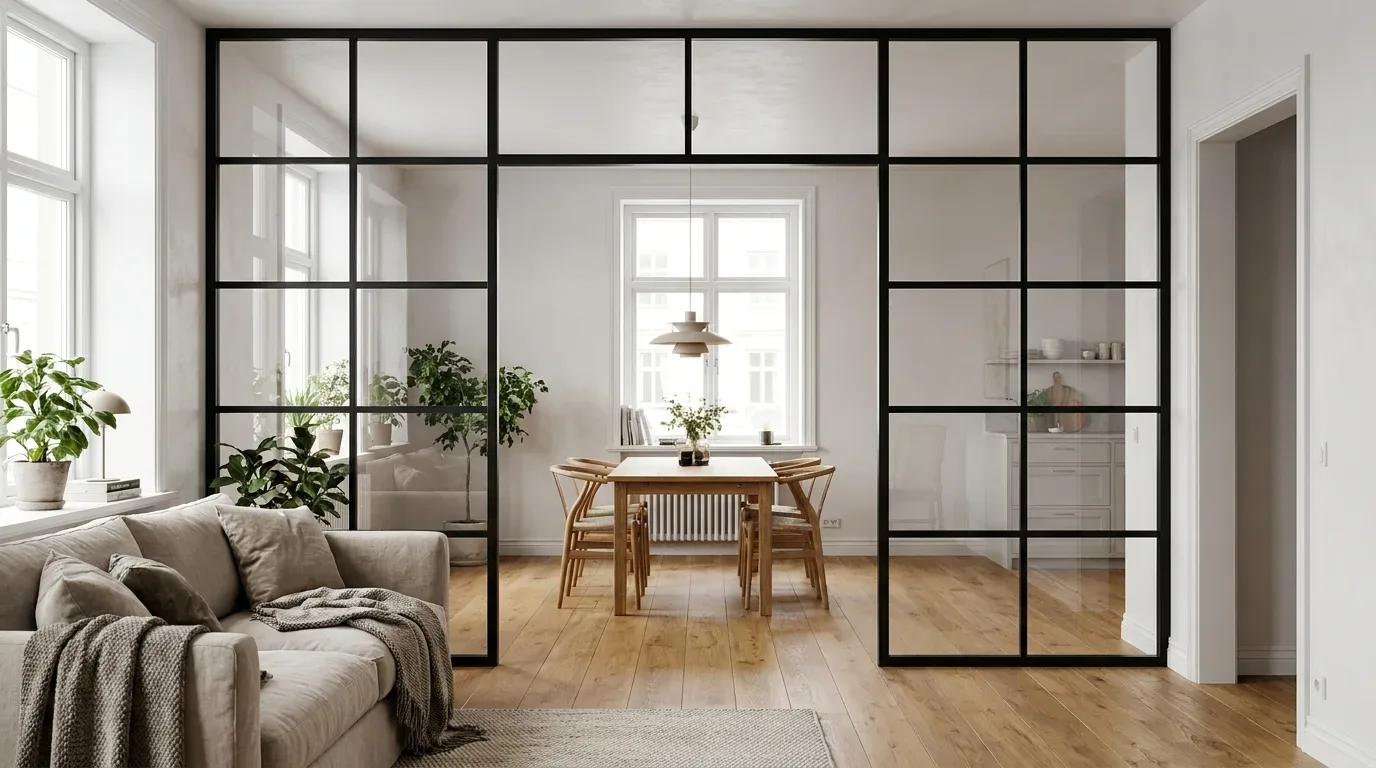
The Manufaktur X room divider is a permanently installed steel-and-glass partition wall - not a movable element. There is no door stop, no opening direction, no handle and no hinges. An open walkthrough can optionally be incorporated as a gap without a door. This makes the room divider ideal for structuring open-plan spaces without closing them off - glass panels keep light moving through the room while the steel frame defines the zone.
Large Shelf - Steel Frame with Solid Wood Shelves
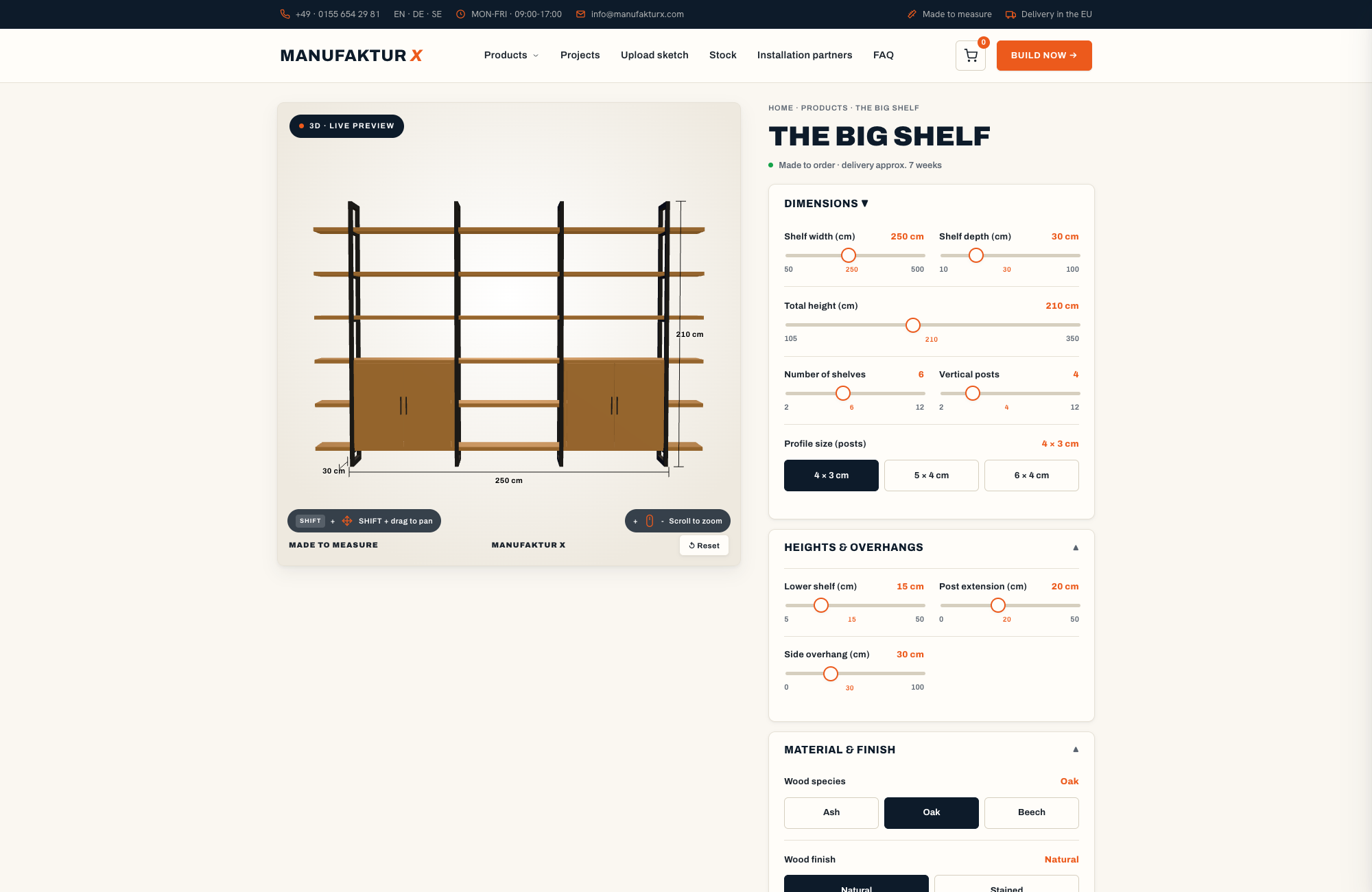
The large shelf pairs a steel frame with solid wood shelving in oak, beech or ash. Optional closed wooden cupboard sections can be integrated. No glass - a pure steel-and-solid-wood construction that works equally well as a room divider, wall-mounted storage unit or display shelving.
Dining Table and Coffee Table - Solid Wood or Veneer Top on a Steel Frame
The dining table and the coffee table combine a wood top in oak, beech or ash with a steel base frame. The top is available either as solid glued-board (genuine solid wood) or as a veneered board - both options are configurable. No particleboard, no glass: two materials that define the industrial aesthetic precisely.
Bench - Solid Wood and Steel
The bench pairs a solid wood or veneer seat in oak, beech or ash with a steel frame. Straightforward, robust and functional - works as a standalone piece or alongside the dining table as a coherent industrial ensemble.
Pipe Shelf - Steel Tube and Solid Wood
The pipe shelf makes the industrial logic explicit: steel tubes as the structural element, solid wood shelves in oak, beech or ash, visible connections throughout. No veneer option, no glass - this one is entirely solid wood and steel.
Five Directions Shaping Custom Industrial Furniture Right Now
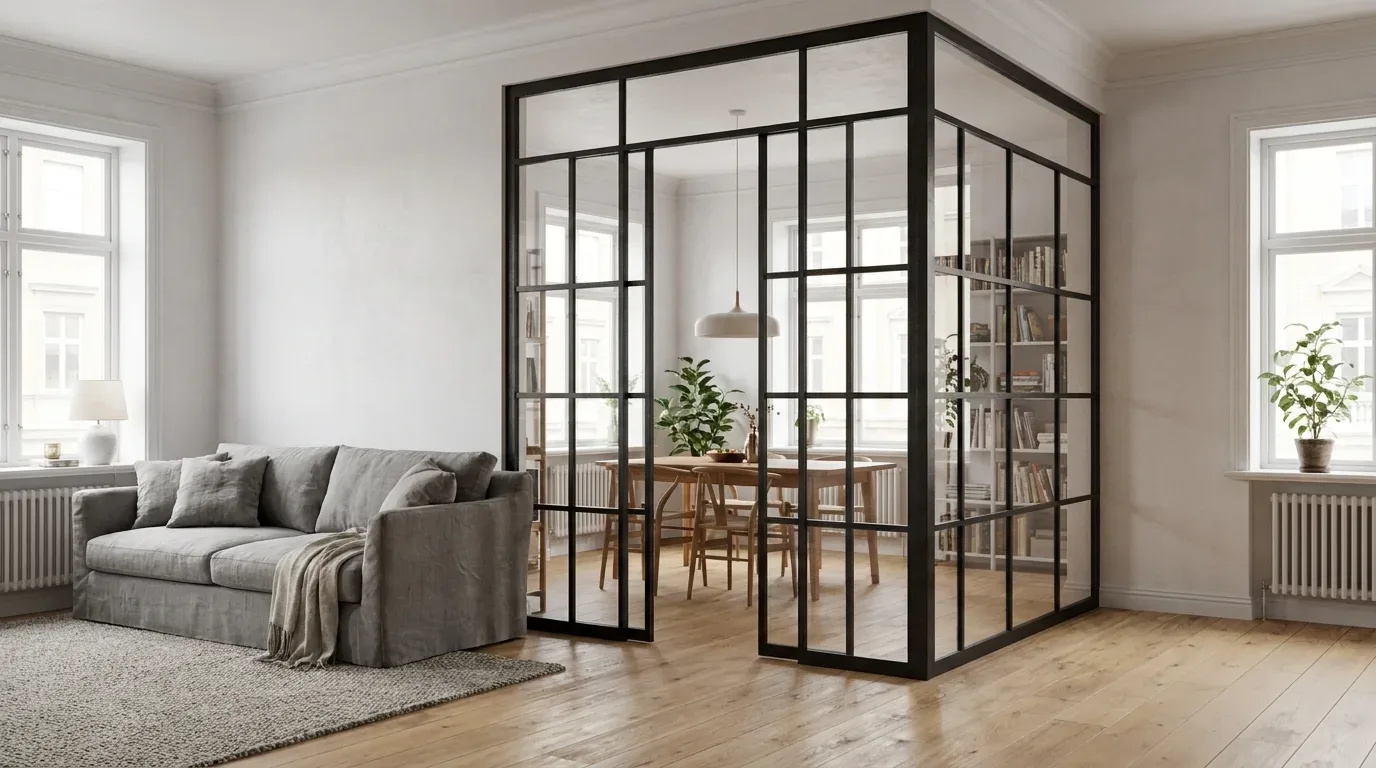
The way people commission and use bespoke industrial pieces is evolving. These are the directions that matter most at the moment.
1. Purposeful Restraint
Less, but more considered. Monochrome colour schemes with a single material accent, room dividers that define zones without creating walls, loft doors that borrow light between rooms while maintaining the option of separation. The restraint makes each element more legible.
2. Materials That Last as a Sustainability Strategy
Solid oak, beech and ash alongside powder-coated structural steel are not marketing claims - they are material science. These materials do not degrade in the way that particleboard swells or laminate peels. Choosing them is a decision about resource use over a twenty or thirty-year horizon, not just a preference for how they look today.
3. Online Configuration with Real-Time Pricing
The 3D configurator at Manufaktur X lets you enter your exact dimensions, choose your wood species, stain, steel colour and glass type, and see both a real-time 3D preview and a live price update simultaneously. Delivery costs and lead times are shown transparently in the cart. There are no hidden additions at checkout - what you see during configuration is what you pay.
4. Flexible Spaces for Multi-Use Living
European apartments - whether a 1960s concrete-frame block in Brussels or a period conversion in Vienna - increasingly need to serve as workspace and living space simultaneously. Custom loft doors and room dividers address this without structural work: home office by day, living room by evening, with a single action. A loft door provides both visual and acoustic separation without permanent division.
5. Visible Craft as a Counter-Position to Mass Production
In a market dominated by flat-pack furniture assembled in an afternoon, visible handcraft and the knowledge of exactly where and how something was made carries genuine value. Each piece from Manufaktur X is produced individually - not pulled from a warehouse, but built after your order is placed.
Bringing the Industrial Style Into Your Home: Room by Room
The industrial aesthetic does not require a converted warehouse or a 4-metre ceiling. It scales. The key is balance - enough rawness to be honest, enough warmth to be liveable.
Structuring Open-Plan Spaces
Open-plan layouts are characteristic of the industrial loft, but they sometimes need definition. A room divider or loft door creates zones without destroying the openness - glass panels keep light flowing, the steel frame provides the industrial character.
The distinction between the two products is worth being precise about. The room divider is a fixed partition - the right choice when you want a permanent spatial structure. The loft door is a functioning door - the right choice when you want the option to open or close the space depending on need.
Combining Materials Effectively
- Steel: As frame, shelf structure or door profile - with or without patina; powder-coated for durability
- Solid wood: As table top, shelf surface or bench seat - oiled, waxed or stained
- Concrete and stone: Raw and unclad as floor or wall surface
- Glass: In combination with steel frames in loft doors and room dividers
The interest comes from contrast: warm against cold, soft against hard, natural against industrial. That tension is not a problem to be resolved - it is the point.
Colour: Keep It Grounded
Greys in several tones, black as an accent, rust and brown for warmth, white for contrast. Colour, if used at all, appears as a single deliberate accent rather than a theme. Powder coating makes any RAL colour possible on steel frames - but the industrial palette itself remains the natural home for this style.
Making the Industrial Style Comfortable
Raw materials can read as cold if they are not balanced with softer elements. The counterweights that work best:
- Deep, generous sofas - leather or heavy linen both work
- Natural textiles: undyed linen, thick cotton, wool throws
- Rugs with geometric patterns or a worn, vintage quality
- Plants - the organic contrast to steel and glass is immediate and effective
- Warm-toned lighting: exposed filament bulbs and metal-shade pendants
The Industrial Style in Smaller Apartments
Not every home has generous proportions, and the industrial style adapts well to more modest spaces. The principle is to choose fewer but more deliberate pieces:
- Wall-mounted pipe shelves with visible steel fittings make use of vertical space without dominating the floor plan
- Loft doors with glass panels extend the perceived depth of a room and borrow light between spaces
- Light surfaces - pale-stained oak, white powder-coated steel - open up smaller rooms
- A single exposed brick or concrete wall can establish the industrial character without overwhelming a small space
How Custom Furniture Is Made at Manufaktur X: The Process
Precision handcraft, CNC machinery and a direct relationship with the customer - this is how each piece is produced.
Step 1: Measuring Your Space Correctly
Measure at several points - walls and floors in real buildings are rarely perfectly straight or level. Always work from the smallest measurement you find: this is what determines whether the finished piece will actually fit. For a loft door specifically, subtract the installation clearance from your smallest measurement - approximately 5 mm per side (left, right and top). This gap allows for fitting and for the natural movement of the door in operation. Manufaktur X produces to the exact dimensions entered in the configurator: the most common reason a custom piece does not fit is a measurement error, not a production fault.
Step 2: Configuring Online
Enter your exact desired dimensions in the online configurator - not the rough opening size, but the dimensions you want the finished piece to be (accounting for any clearance you have already subtracted). Select your wood species, stain finish, steel colour and, for glass products, your glass design and glass type. The price updates in real time throughout. No hidden costs appear at checkout.
Step 3: Custom Requests via Sketch Upload
For unusual room situations - a sloped ceiling, an asymmetric opening, a room divider that needs to work around a structural column - you can upload a sketch directly to the Manufaktur X team. The team reviews feasibility and provides an individual quotation.
Step 4: Production and Delivery
After your order is confirmed, production begins: CAD design for precision planning, CNC cutting for exact dimensions, and manual finishing and assembly. In our production, the powder coating process for steel frames runs through a full oven-cure cycle - this is what gives the finish its scratch resistance and colour consistency that ordinary paint cannot match. Production takes 5 to 6 weeks. The finished piece is then delivered directly to you.
Pricing: What Does a Custom Industrial Piece Cost?
The entry-level loft door configuration starts at €1,157. The exact price depends on the dimensions you enter, your choice of glass design, glass type, handle design and any additional options - all of this is calculated and displayed in real time as you configure. For all other products, current starting prices are visible directly in the respective configurator or in the price overview below.
| Product | From | Note |
|---|---|---|
| Lofttür | 1.157 € | Lowest possible option |
| Raumteiler | 2.212 € | Steel + laminated glass, custom width |
| Großes Regal | 3.200 € | Solid wood, steel frame, floor-to-ceiling |
| Esstisch | 1.580 € | Solid wood, steel frame |
| Couchtisch | 1.155 € | Solid wood, steel frame |
| Sitzbank | 1.100 € | Solid wood, steel frame |
| TV-Board | 1.540 € | Solid wood, steel frame |
| Rohrregal | 1.065 € | Modular pipe shelf |
Loft Door vs. Room Divider: The Key Differences
These two products are frequently confused - but they serve fundamentally different functions.
| Feature | Loft door | Room divider |
|---|---|---|
| Function | Functioning door, movable | Fixed partition wall, not movable |
| Door stop | Yes - left or right, your choice | No |
| Opening direction / angle | Yes - configurable | No |
| Handle | Yes (Long, Subtle or Half-moon) | No |
| Hinges | Yes | No |
| Walkthrough | By opening the door | Optional as an open gap without door |
| Glass options | 5 (Clear, Frosted, Smoked, Dark smoked, Textured) | 5 (Clear, Frosted, Smoked, Dark smoked, Textured) |
| Steel finish | Any RAL colour | Any RAL colour |
Industrial Style and Industrial Design: Not the Same Thing
Industrial design as a professional discipline is broader than a furniture style. As a problem-solving process, it encompasses function, ergonomics, manufacturing economics and user experience - the discipline that produces everything from a hospital chair to a household appliance.
When the term appears in furniture, "custom industrial design furniture" refers specifically to pieces made according to the visual and material principles of the industrial style: raw materials, visible construction, functional aesthetics and individual sizing. That is the core work at Manufaktur X - not a design consultancy, but a maker of specific objects in specific materials to specific dimensions.
| Aspect | Industrial design (discipline) | Industrial style (interiors) |
|---|---|---|
| Focus | User experience, function, production economics | Aesthetic of industrial materials and construction |
| Goal | Practical and appealing products for broad use | Authentic, characterful living spaces |
| Materials | Varies by product | Steel, solid wood, concrete, glass |
| Process | Research, prototyping, testing, manufacture | Material selection, craft, custom sizing |
Caring for Industrial Furniture: What You Actually Need to Do
Custom-made industrial furniture lasts for decades - with straightforward, low-effort maintenance.
Caring for Solid Wood
- Oil or wax the surface regularly to keep the wood supple and protect against moisture
- Avoid prolonged direct sunlight and very low humidity - both cause wood to move and crack over time
- Light surface scratches can be addressed by gentle sanding along the grain followed by re-oiling
- Wipe spills immediately - solid hardwood is robust but not impermeable to water
Caring for Powder-Coated Steel
- A damp cloth is sufficient for routine cleaning - powder-coated surfaces require no special products
- Avoid abrasive cleaners and scouring pads, which will damage the coating
- Any chips or scratches in the powder coating should be touched up promptly to prevent rust forming at the exposed metal
Cleaning Glass Panels
- Clean ESG and VSG panels with standard glass cleaner and a lint-free cloth
- No abrasive products - these will scratch the surface and, on textured or frosted glass, damage the finish permanently
- Fingerprints on clear glass are visible; a weekly wipe-down keeps the transparency you chose it for
Configure Your Custom Piece - Start Now
If you know what you want - a room that actually works for the way you live, furniture that belongs in its space rather than happening to be there - the next step is straightforward. Open the configurator, enter your exact dimensions, choose your materials and see the price update in real time.
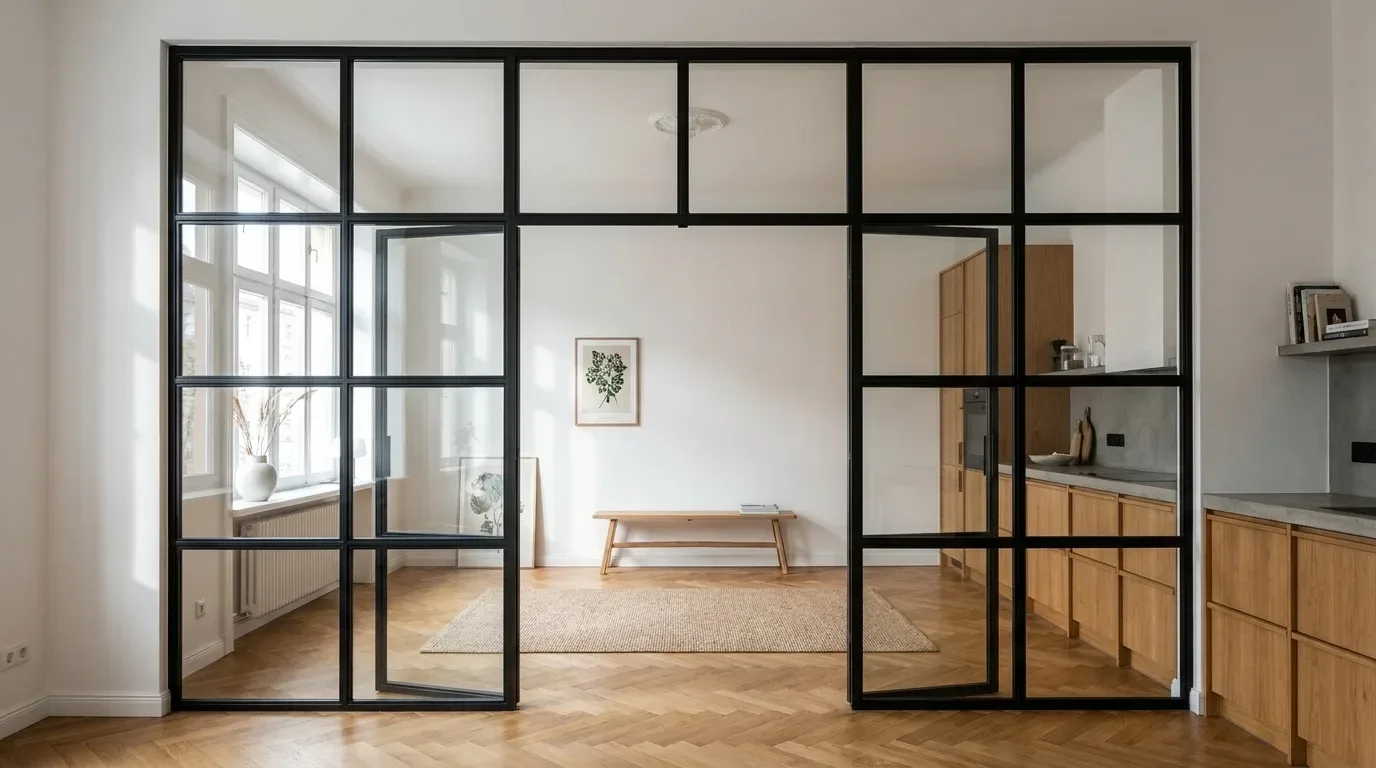
For unusual spaces or requirements that fall outside the standard configurator, upload a sketch and request an individual quotation from the Manufaktur X team. Production takes 5 to 6 weeks from confirmed order, and delivery goes directly to your address across Europe.
Manufaktur X builds to your measurements - not to whatever happens to be available off the shelf.
Frequently Asked Questions About Custom Industrial Furniture
What makes custom industrial furniture different from standard furniture?
Custom industrial furniture is produced individually to your specified dimensions, in materials that define the industrial style: solid hardwood (oak, beech or ash) and powder-coated structural steel. Unlike mass-produced furniture, each piece is built after your order - not selected from a warehouse stock. The result fits your space precisely and develops a genuine patina over time rather than simply ageing.
Which wood species does Manufaktur X use?
Manufaktur X works exclusively with three European hardwoods: oak, beech and ash. All three offer strong natural grain, proven durability and the hardness needed for furniture that is used daily. Over 50 stain finishes are available to adjust tone and shade.
What is the difference between a loft door and a room divider?
A loft door is a functioning door: it has a door stop (left or right), a configurable opening direction and angle, hinges, and a choice of three handles. A room divider is a fixed, permanently installed steel-and-glass partition with no moving parts - no handle, no hinges, no door stop. An open walkthrough gap can optionally be included in the room divider design.
What glass options are available?
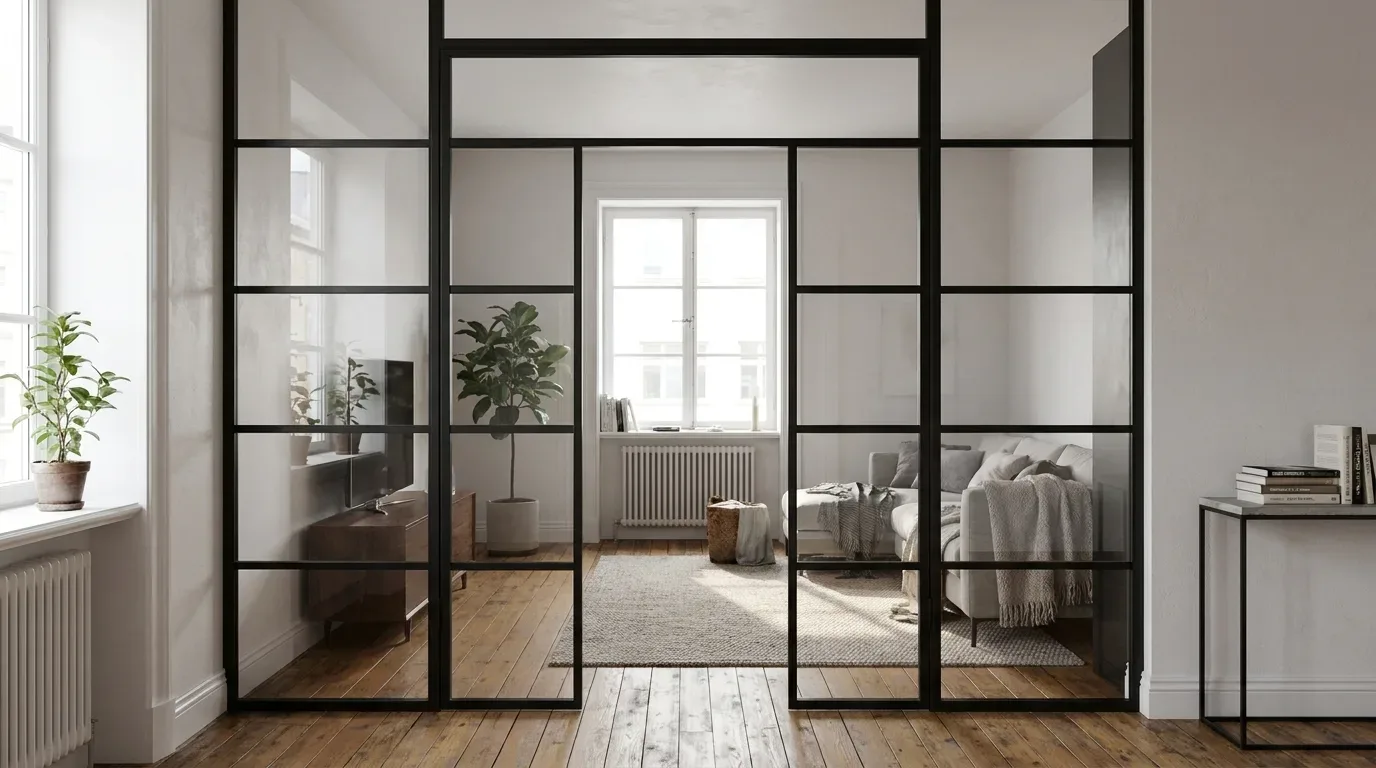
Five glass designs are available for both the loft door and the room divider: clear, frosted, smoked, dark smoked and textured. For glass type, you can choose between ESG (toughened single-pane safety glass) and VSG (laminated safety glass). For larger dimensions, VSG is recommended because the bonded construction keeps the glass in place if it is broken.
How do I measure correctly for a custom order?
Measure at multiple points and always use the smallest measurement you find - real walls and floors are rarely uniform. You enter your exact desired finished dimensions in the configurator (not the rough opening). For a loft door, subtract approximately 5 mm per side (left, right and top) from your opening to allow for the installation clearance the door needs to operate. The most common fitting problem with custom furniture is a measurement error made before ordering, not a production error.
How long does production take and where are pieces made?
Production takes 5 to 6 weeks from confirmed order. All pieces are made in the EU. Delivery goes directly to your address; costs and timing are shown transparently in the checkout before you confirm your order.
What is the starting price for a loft door?
The most basic loft door configuration starts at €1,157. The exact price depends on your chosen dimensions, glass design, glass type and handle - all calculated and shown in real time as you configure.
Can the industrial style work in a smaller apartment or a period building?
Yes, and it often works particularly well. In a smaller flat, the key is to use fewer but more deliberate pieces - a pipe shelf with visible steel fittings, or a loft door with glass panels that extends the perceived depth of the room. In a period apartment with ornate plasterwork or high ceilings, a custom steel-and-glass loft door creates a striking dialogue between historical architecture and contemporary industrial materials - neither element cancels the other out.