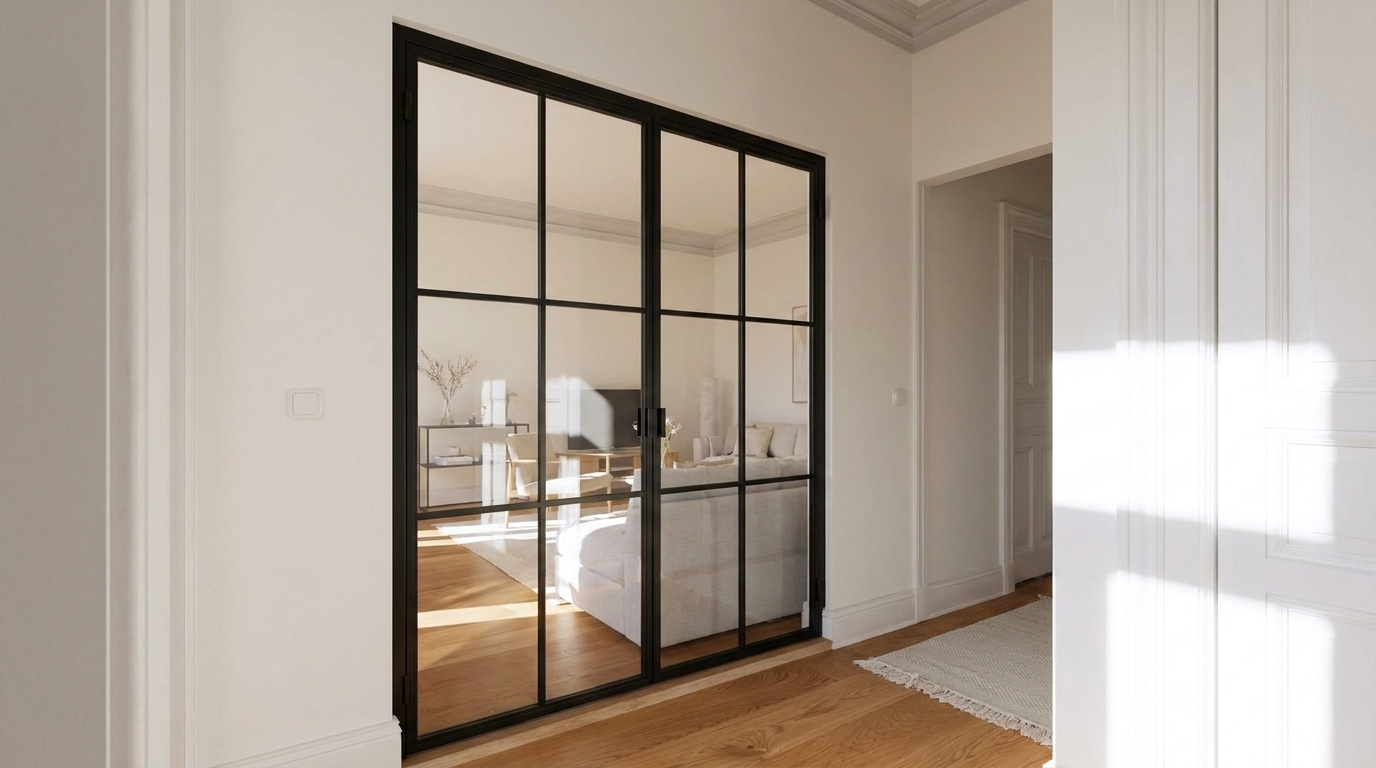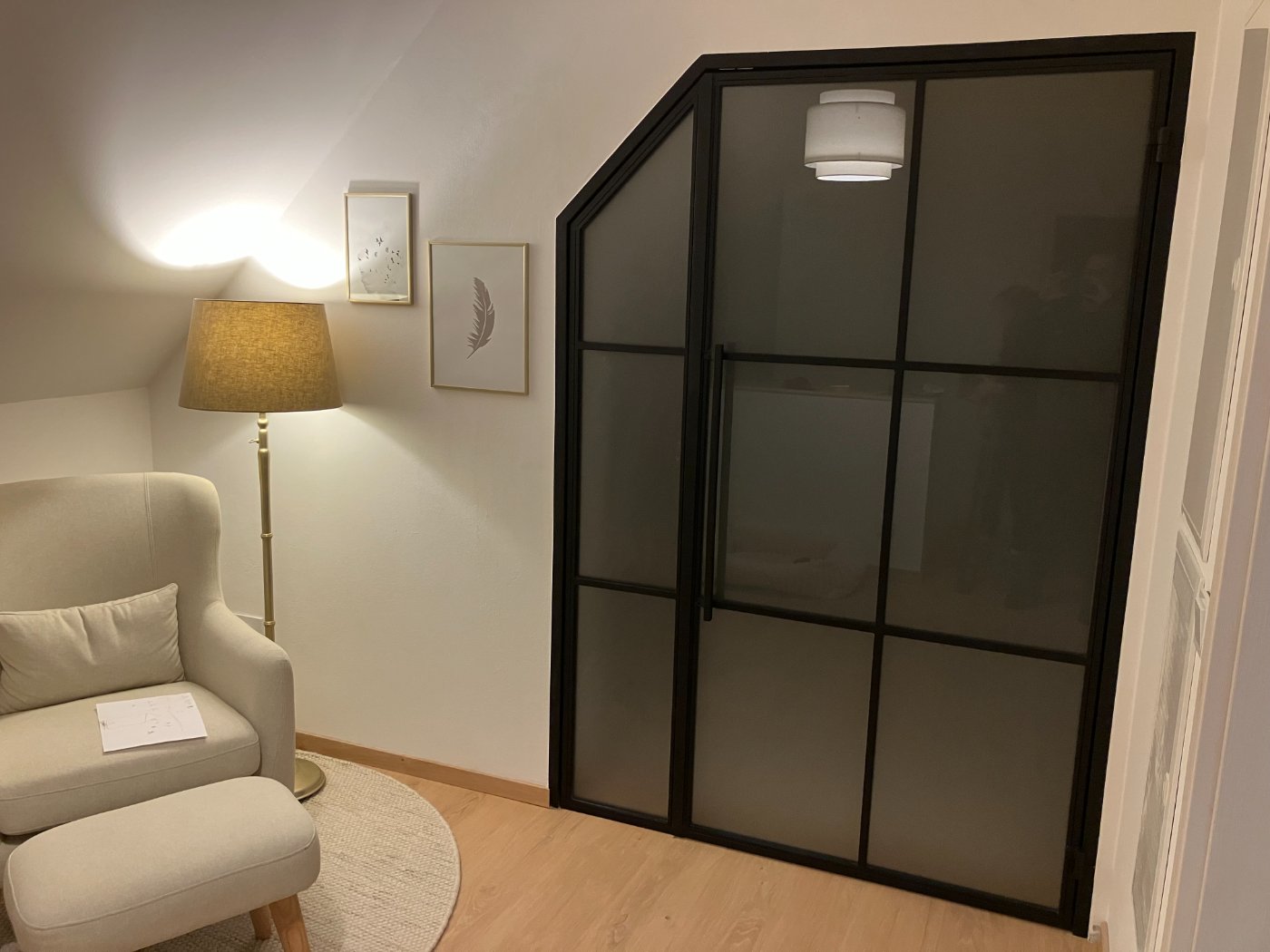
There are spaces that simply refuse to cooperate with standard furniture. The ceiling is a little too high, the wall a little too wide, the alcove a little too narrow — and suddenly the options in any high-street catalogue run dry. Custom furniture exists precisely for these situations. This guide walks you through every stage of the process: from identifying what you actually need, through choosing the right materials, to placing your order with confidence. Along the way, you will see how solid wood, powder-coated steel and safety glass can come together in pieces that fit your home as though they were always part of it.
Does Your Space Really Need Custom Furniture?
The honest answer is: not always. Standard furniture is well-suited to rooms with conventional proportions, straightforward layouts and no unusual requirements. If your walls are square, your ceiling is at a typical height and you have no particular preferences about materials or finish, a ready-made piece may serve you perfectly well.
Custom furniture becomes the more sensible choice when the room itself makes standard solutions impractical. Older buildings across Europe — from pre-war apartments in Vienna to converted warehouses in Amsterdam — frequently feature ceiling heights above 2.8 m, non-rectangular floor plans or built-in structural elements that leave awkward gaps. A shelf that reaches only 2.2 m in a room with a 3 m ceiling creates a visual gap that is difficult to ignore and impossible to fill with off-the-shelf products. A dining table offered in lengths of 160 cm and 200 cm simply cannot occupy a wall recess that measures 178 cm.
How Much Space Can a Custom Piece Unlock?
Consider a top-floor apartment with sloping ceilings on two sides. A shelf unit designed to follow the angle of each slope can recover roughly 0.8 m² of usable storage per slope — space that would otherwise be permanently wasted. Across both sides, that is an additional full shelf section. A custom dining table built to the precise width of an awkward dining area avoids the visual imbalance of a table that is obviously too small or too large for the room.
Beyond geometry, custom furniture offers something that ready-made pieces rarely can: the ability to define the character of a room. A well-proportioned piece in the right material does not just occupy space — it organises sight lines, guides movement through the room and anchors the atmosphere you are trying to create.
Durability as a Practical Argument
Solid wood — whether oak, beech, ash, walnut, pine or cherry — is a repairable material. Scratches can be sanded out and re-oiled. Surfaces can be refreshed without replacing the piece. Steel frames with powder coating are corrosion-resistant and mechanically robust; if the finish is ever damaged, the frame can be re-coated. Compare this with MDF or particleboard furniture, where surface damage is typically irreversible.
Looked at over a twenty-year horizon, the economics can be surprisingly close. A solid wood and steel shelf purchased once, maintained occasionally and repaired if needed may represent a lower total cost than replacing a cheaper piece every four or five years — while also producing less waste.
Five Steps from Idea to Finished Piece
| Step | What to do |
|---|---|
| 1. Define your requirements | Analyse the room, its use, the functions you need and the aesthetic you want |
| 2. Measure and choose materials | Measure multiple times, take the smallest reading, decide on wood species and surface finish |
| 3. Configure online | Build your piece in the 3D configurator, watch the price update in real time |
| 4. Review every detail | Check all dimensions and specifications carefully before confirming |
| 5. Order and prepare for delivery | Complete your order, plan the delivery logistics and organise installation |
Step 1 — Understanding What You Actually Need
Good planning begins with honest observation. Before you think about wood species or steel colours, spend some time in the room you are furnishing. Notice how light moves through it at different times of day. Think about how many people use it, what they do there and what a piece of furniture needs to do to genuinely improve the experience of being in that room.
Write down the answers to a few practical questions:
- Function: How much storage do you need? Do you need work surfaces, display areas or both?
- Room constraints: Where are the windows, doors, radiators and sockets? Are there alcoves, beams or sloped ceilings?
- Usage patterns: Will children use this furniture daily? Is it primarily decorative or primarily practical?
- Visual style: What is the existing character of the room, and do you want the new piece to blend with it or contrast deliberately?
- Future flexibility: Might you move to a different property in a few years? If so, will the piece work in a different context?
Photograph the space from multiple angles. If you want to understand how a piece will feel in the room before it arrives, use masking tape on the floor to mark its footprint. This simple trick makes it immediately clear whether you will still be able to open the door comfortably or whether the proportions you have in mind actually work at full scale.
| Style direction | Typical palette | Characteristic materials |
|---|---|---|
| Contemporary | Greys, white, black | Steel, glass, smooth wood |
| Classic | Beige, brown, dark green | Oak, solid wood, leather |
| Scandinavian | Light pastels, off-white | Light solid wood, linen |
| Industrial | Anthracite, raw wood tones | Steel, exposed concrete, solid wood |
Time spent in this phase is never wasted. The more clearly you understand what you need, the more precisely the finished piece will deliver it.
Step 2 — Measuring Accurately and Choosing Your Materials
This is where ideas become specifications. Two things matter enormously here: taking precise measurements and making material choices based on how the furniture will actually be used — not just how it looks on a screen.
How to Measure Correctly
Walls are rarely perfectly straight, and floors are rarely perfectly level. In older buildings, the difference between what architectural drawings show and what actually exists on site can easily reach two to five centimetres. Measure height, width and depth at a minimum of three points each — top, middle and bottom for height; left, centre and right for width. Always work with the smallest reading you obtain.
- Height: Floor to ceiling at several points across the room
- Width: The available wall span at multiple heights
- Depth: The distance available without blocking doorways or circulation routes
- Note the exact positions of radiators, sockets, light switches and any fixed architectural features
Sketch the space with all measurements marked. A laser distance measurer is worth using if you have access to one — it eliminates the small errors that accumulate when using a tape measure alone.
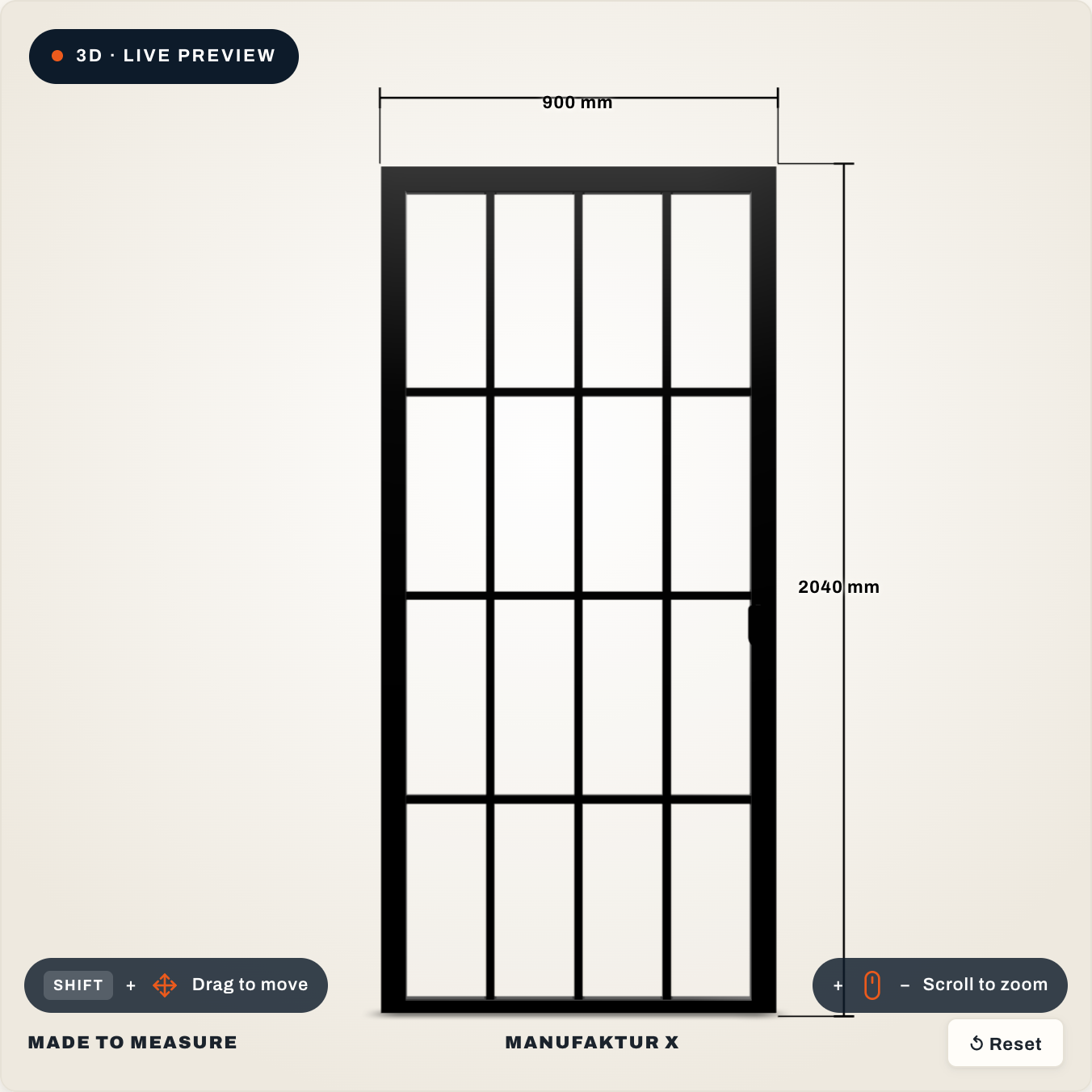
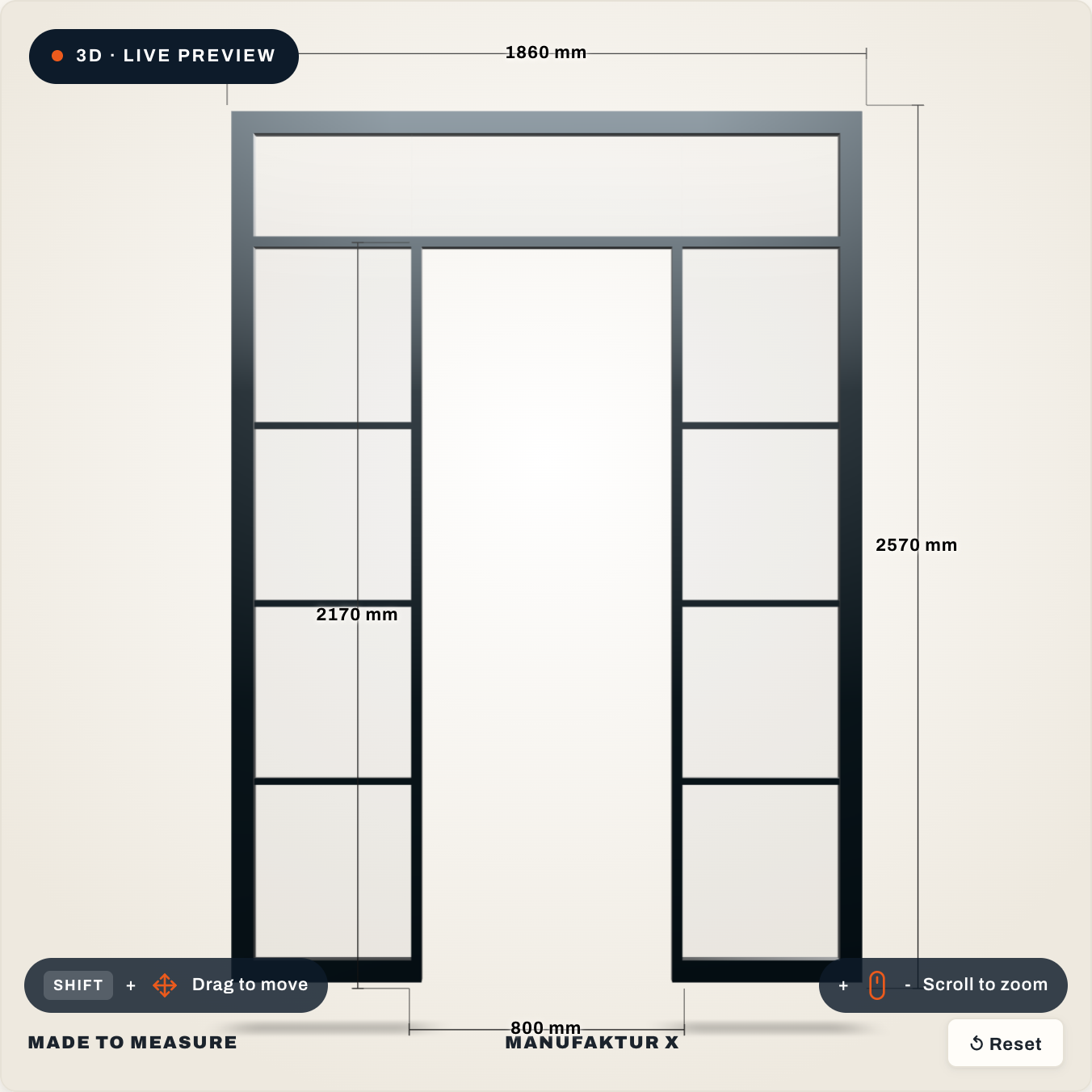
Important for loft doors: You enter your exact desired finished dimensions into the configurator — not the raw opening measurement. Allow approximately 5 mm clearance on each side (left, right and top) as an installation gap, and deduct this from your smallest measured dimension before entering it.
Professional tip: Photograph your measurements as you take them, with the tape measure visible in the frame. This gives you a permanent reference and helps catch inconsistencies before you configure.
Choosing Your Wood Species
Manufaktur X works exclusively with solid hardwoods. Each species has distinct characteristics that go beyond appearance:
| Wood species | Character and appearance | Best suited for | Notable property |
|---|---|---|---|
| Oak | Rich grain, classic warmth | Dining tables, shelves, loft doors, high-traffic surfaces | Brinell hardness approx. 3.7 — very resistant to denting |
| Beech | Even tone, clean and stable | Worktops, benches, large shelf surfaces | Brinell hardness approx. 3.8 — highly uniform grain |
| Ash | Lighter colour, lively grain | Coffee tables, dining tables, modern interiors | Brinell hardness approx. 3.5 — naturally elastic |
| Walnut | Deep brown, sophisticated | Statement pieces, living room furniture | Distinctive dark tone, ages beautifully |
| Pine | Pale, relaxed, informal | Casual settings, country-style interiors | Lighter weight, warm character |
| Cherry | Warm reddish tone, refined | Classic furniture, dining rooms | Deepens in colour over time with light exposure |
For a dining table used every day by a family, oak or beech will outperform ash in terms of resistance to everyday wear. Ash photographs beautifully and tends to look lighter and more open in images — but this should not be the deciding factor when longevity matters.
Surface Finish: Wood Stains and Powder Coating
The surface treatment affects both the look and the long-term behaviour of the piece. For the wood, more than 50 stain finishes are available — ranging from pale natural tones through mid-range warm finishes to deep, dark patinas. Oiled solid wood absorbs the protective treatment into the grain itself, which means scratches can be sanded back and re-oiled without rebuilding the surface from scratch. Note that switching surface treatment after the piece has been manufactured is not possible without stripping it entirely.
Steel frames receive powder coating rather than paint. This process produces a finish that is more even, more durable and more resistant to scratching than liquid paint, and it carries no solvent emissions during application — making it the more environmentally responsible choice. Any RAL colour is available. When choosing your RAL colour, be aware that screen representations of powder-coated finishes can differ meaningfully from how the colour reads in your actual room. RAL 7016 — anthracite grey — can appear almost black on a calibrated monitor but read considerably lighter in a bright room with indirect natural light. Request a physical colour sample and evaluate it in the actual lighting conditions of the space where the furniture will stand. Matte finishes are more susceptible to this variation than gloss surfaces.
Step 3 — Designing Your Piece in the Online Configurator
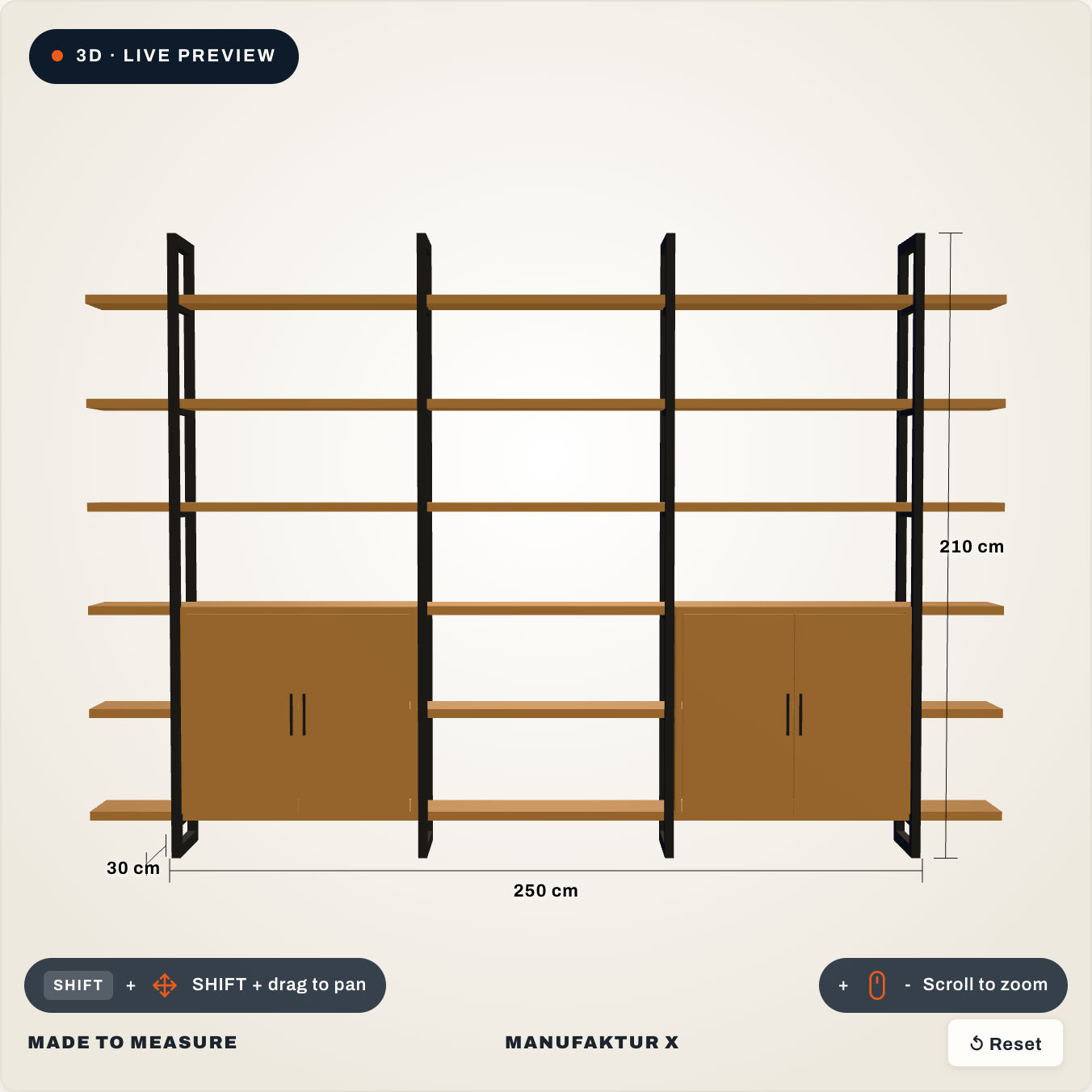
The Manufaktur X 3D configurator is where your specifications become a visible, priced object. Every change you make — adjusting a dimension, switching wood species, choosing a different RAL colour — updates the price immediately. There are no hidden extras: the figure shown is the figure you pay. Delivery costs and lead times are displayed transparently in the basket before you commit to anything.
- Select the product you want: loft door, dining table, large shelf, bench and more
- Enter your exact desired dimensions — always using the smallest measurement you recorded
- Choose your wood species and stain finish
- Select your steel RAL colour and surface type
- Configure hardware details such as handles and fittings
- Try multiple variations — compare different species, colours or proportions before deciding
One thing worth doing at this stage: hold your configuration against a rough sketch of the room. A piece that is dimensionally correct can still feel proportionally wrong if, for example, it leaves less than 90 cm of clear circulation space in front of it. The configurator gives you the numbers; the sketch gives you the spatial reality check.
If your project falls outside the configurator's standard parameters — an unusually shaped opening, a structural element that needs to be worked around — you can upload a sketch and request a custom quote. The team will assess feasibility and come back with a concrete proposal.
The real advantage of the online configurator is that experimenting costs nothing. Every variation is visible and priced instantly, so you can explore freely before committing.
Step 4 — Reviewing Your Configuration Before You Order
Once your configuration is complete, take a deliberate pause before clicking through to payment. This is the last point at which changes are straightforward. After production begins, adjustments are not possible.
Go through the following systematically:
- Dimensions: Do the height, width and depth in your configuration match the measurements you took on site?
- Clearances: Have you accounted for doors that swing into the space, radiators, and sockets?
- Material choices: Did you select the wood species based on how the piece will actually be used, rather than only how it looked in a product image?
- Glass specification: For loft doors and room dividers, have you distinguished between glass type (clear, frosted, smoked, dark smoked or textured) and glass design (the bar pattern within the frame)?
- Hardware: Are the handle style, foot design and hinge direction exactly as you want them?
- RAL colour: Have you assessed the colour using a physical sample in your room's actual lighting — not only from a screen?
Your complete configuration summary, including all dimensions, materials and delivery costs, is available in the basket. Read through it carefully. If anything is unclear, uploading a sketch and requesting a quote is always an option.
| Common issue | Likely cause | How to avoid it |
|---|---|---|
| Poor fit after delivery | Measurements taken from plans rather than on site | Measure in person, at multiple points, use the smallest reading |
| Wrong material for the use | Selection based on screen appearance only | Choose wood species by hardness requirements; evaluate RAL colours by physical sample |
| Visual result not as expected | No real-time preview consulted | Use the configurator's live rendering to test every variation |
| Piece doesn't function as intended | Functional requirements not defined upfront | Document intended use before configuring |
| Installation difficulties | Installation gap not factored in | Deduct clearance from measured dimensions before entering them |
A thorough check at this stage costs ten minutes. Discovering a problem after delivery costs considerably more — in time, effort and disappointment.
Step 5 — Placing Your Order and Preparing for Delivery
- Confirm the lead time: Production takes 5–6 weeks. This is shown clearly in your basket so you can plan accordingly.
- Check your contact details: Make sure your delivery address and phone number are correct so the courier can reach you.
- Assess access: Can large furniture be brought into the room? Measure stairwells, corridor widths and doorframes in advance.
- Prepare the space: Move existing furniture out of the way and protect flooring and walls near the delivery route.
- Organise help: Share the delivery date with someone who can assist — an extra pair of hands makes unboxing and positioning considerably easier.
- Allow time for installation: Set aside adequate time and gather the tools you will need before the piece arrives.
- Document the condition on arrival: Photograph the packaging and the piece itself before and during unboxing. This is useful if any claim ever becomes necessary.
Keep your order confirmation and any related correspondence. If you are replacing existing furniture, decide in advance whether you will sell it, donate it or arrange collection for recycling.
Materials in Detail: Glass, Steel and Wood Surfaces
Glass Types for Loft Doors and Room Dividers
For loft doors and room dividers, five glass types are available:
- Clear glass — maximum transparency, open and airy feel
- Frosted glass — diffuses light while providing a degree of visual privacy
- Smoked glass — tinted, reduced transparency
- Dark smoked glass — stronger tint for greater privacy
- Textured glass — patterned surface with a decorative quality
Each glass type is available as either ESG (single-pane safety glass) or VSG (laminated safety glass). The two are visually indistinguishable, but they behave very differently if broken. ESG shatters into small, blunt fragments. VSG consists of two glass layers bonded by a plastic interlayer; if broken, the interlayer holds the pane together and prevents fragments from falling. For larger dimensions, VSG is the recommended choice. Note that glass type — what the glass is made of and how it behaves — is a separate decision from glass design, which refers to the bar or division pattern within the frame.
Handles for Loft Doors
Three handle styles are available for loft doors: Long, Discreet and Crescent. The handle is a small detail that has a disproportionate effect on the overall character of the door, so it is worth considering in the context of your wider interior style.
Steel Frames and Powder Coating
Steel frames are fabricated from raw steel and finished with powder coating — a process that produces a corrosion-resistant, mechanically robust surface that can be re-coated if necessary. The full RAL colour palette is available. Powder coating is applied electrostatically and cured under heat, which results in a more even, durable and scratch-resistant finish than conventional liquid paint, and produces no solvent emissions during manufacture.
Which Custom Furniture Piece Works Best in Which Room?
Custom furniture is most valuable where standard products create compromises. Here is a practical overview by product type:
- Loft doors: Divide open-plan spaces while preserving light and visual connection. Well suited to industrial, contemporary and loft-style interiors. Starting from €1,157 for the most basic configuration.
- Room dividers: Create zones within open spaces without building permanent walls — ideal for combined living and dining areas or flexible home offices.
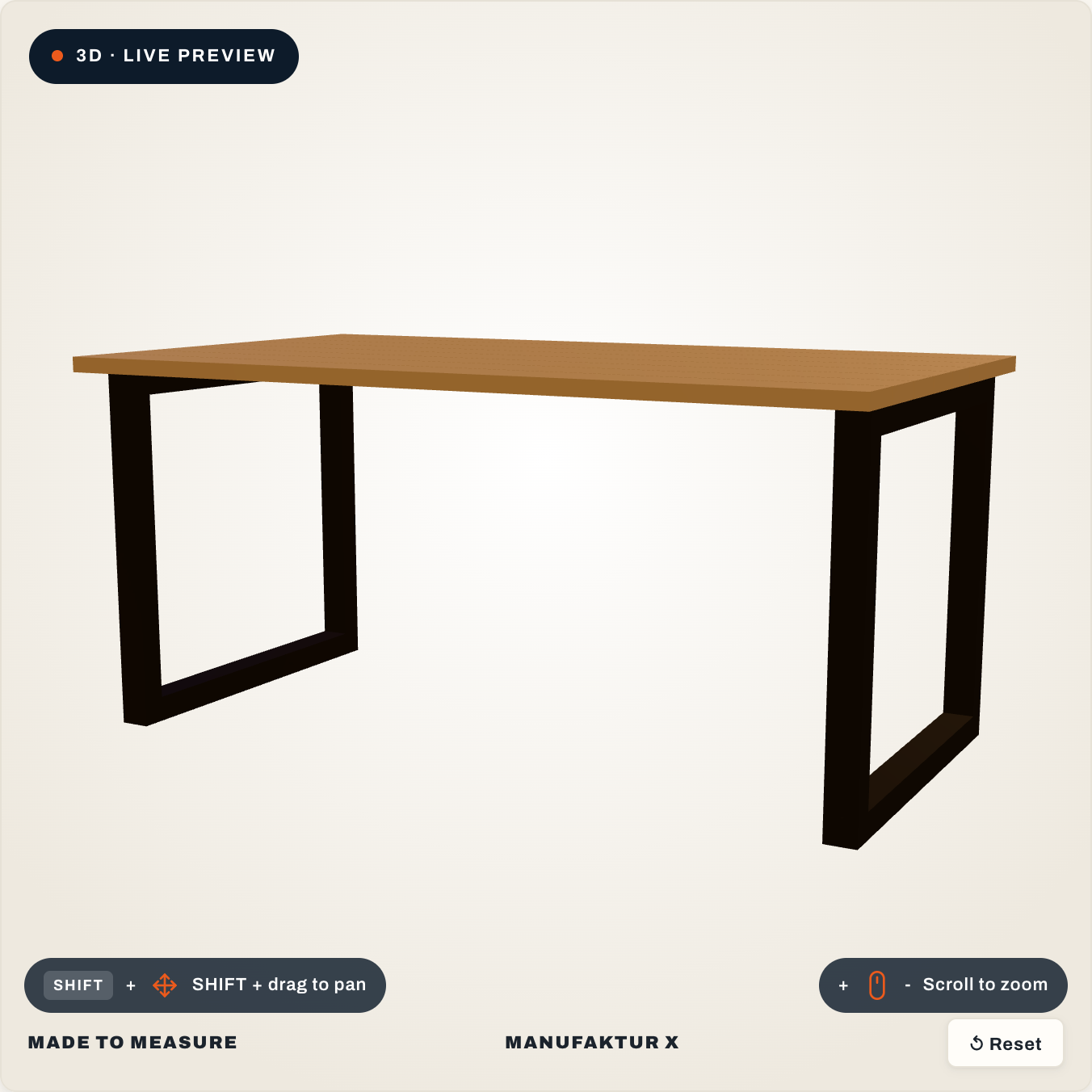
- Dining tables: Available in any length and width, so the table can be built to the actual room rather than the other way around.
- Large shelves: Floor-to-ceiling solutions that close the gap between the top of a standard shelf and the ceiling — particularly relevant in buildings with generous ceiling heights.
- Coffee tables: Proportioned precisely to the sofa arrangement rather than selected from a limited range of standard sizes.
- Benches: Custom-length solutions for entrance halls, dining areas or window seats.
Custom Furniture in Living Spaces: Dividers, Shelves and Tables
Living rooms are the most common context for custom furniture — and with good reason. Open-plan layouts, which became standard in new residential construction across Europe over the past two decades, create rooms that feel undefined without some structure to anchor different areas. A room divider in steel and clear or frosted glass separates the seating area from the dining zone without blocking daylight. A floor-to-ceiling shelf transforms the space above a standard-height bookcase from a dust-collecting void into organised, usable storage. A coffee table configured to the exact footprint of a sofa arrangement sits in the space as though it was always there.
Custom Furniture in Work Environments
Contemporary workplaces — whether a home office carved out of a spare room or a professional studio — have specific demands that standard furniture rarely meets cleanly. A desk that fills an alcove completely, a shelving system that uses the full height of a room with a structural beam partway up, a reception counter that fits a specific lobby footprint: these are configurations that require custom production.
Useful ergonomic benchmarks for work furniture: worktop height between 68 and 76 cm for comfortable arm positioning; at least 60 cm of legroom depth beneath the surface; storage within reach without twisting the upper body. If you are planning a shared work environment, involving the people who will use it in the planning process produces better outcomes than specifying everything in isolation.
- Survey the space: Record dimensions, lighting conditions, circulation routes and existing infrastructure.
- Identify functional requirements: What work happens here? What does that require in terms of surfaces, storage and collaboration space?
- Define zones: Separate focused work areas from collaborative spaces and storage areas before specifying individual pieces.
- Select materials for the context: High-traffic surfaces benefit from harder wood species and durable finishes.
- Configure and preview: Use the configurator to visualise the finished result before committing to production.
Pricing and Cost Factors: What Does Custom Furniture Actually Cost?
Prices vary with complexity, dimensions and material choices. The primary cost drivers are solid wood, specialist surface treatments and the craftsmanship involved in precise custom production. When forming a budget, it is worth thinking beyond the purchase price to consider longevity, repairability and the cost of replacement over time.
Loft doors from Manufaktur X start at €1,157 for the most basic configuration. Current entry prices for all products are shown below:
| Product | From | Note |
|---|---|---|
| Lofttür | 1.157 € | Lowest possible option |
| Raumteiler | 2.212 € | Steel + laminated glass, custom width |
| Großes Regal | 3.200 € | Solid wood, steel frame, floor-to-ceiling |
| Esstisch | 1.580 € | Solid wood, steel frame |
| Couchtisch | 1.155 € | Solid wood, steel frame |
| Sitzbank | 1.100 € | Solid wood, steel frame |
| Rohrregal | 1.065 € | Modular pipe shelf |
The configurator at manufakturx.com calculates a fixed price with every change you make. The price shown is the price you pay — no additions after the fact. Delivery costs and lead times are shown in the basket before you order.
Six Mistakes to Avoid When Planning Custom Furniture
Trusting Plans Instead of Taking Your Own Measurements
Architectural drawings record the intended design, not necessarily what was built. In older properties, the difference between plan and reality regularly exceeds two centimetres — and can reach five. A piece produced to plan dimensions that differ from actual site conditions cannot be adjusted after delivery. Measure in person, at multiple points, and use the smallest reading as your basis for configuration.
Choosing Wood Species and Glass Based on Photographs Alone
Ash photographs lighter and friendlier than oak — but for a dining table subjected to daily family use, the higher hardness of oak or beech makes it a more practical choice. ESG and VSG look identical in product images but behave very differently under stress. Make both decisions based on function, not appearance.
Selecting RAL Colours Without a Physical Sample
Screen colour and physical powder-coated colour can diverge significantly — particularly with matte finishes, which are more variable than gloss. Always request a physical sample and assess it in the room's actual lighting conditions at different times of day before ordering.
Forgetting the Installation Gap
For loft doors in particular: enter your desired finished dimensions into the configurator, having already deducted approximately 5 mm per side (left, right and top) for the installation gap. A door produced to the exact opening measurement will not fit. This is among the most common and most avoidable errors in the ordering process.
Overlooking Circulation Space
A table or shelf that is correctly dimensioned for the wall it occupies can still make a room feel cramped if it leaves less than 90 cm of clear walking space in front of it. Use your floor sketch to verify that the piece you are configuring leaves comfortable room to move around it.
Ignoring Colour Harmony with Existing Furniture
A new custom piece does not exist in isolation — it will live alongside existing furniture, flooring and walls. The configurator allows you to test different combinations freely before committing. Use this to assess whether the finish you have chosen works with what is already in the room, not just in isolation.
Caring for Custom Furniture: Solid Wood, Steel and Glass
Properly maintained, custom furniture in solid wood, powder-coated steel and safety glass will remain functional and visually appealing for decades. Each material has its own requirements:
- Solid wood: Oil or wax the surface every 12 to 18 months. Clean with a lightly dampened cloth and avoid aggressive cleaning products. Scratches on oiled surfaces can be sanded back and re-oiled without affecting the surrounding finish.
- Powder-coated steel: Wipe with a dry cloth to remove dust. The coating is robust and requires minimal maintenance under normal conditions.
- Glass: Clean with a standard glass cleaner. Avoid abrasive materials that could scratch the surface.
- General: Keep furniture away from prolonged direct sunlight, which can cause fading and accelerate surface degradation. Inspect periodically for any damage that would benefit from early attention.
Configure Your Custom Furniture at ManufakturX
The Manufaktur X 3D configurator gives you complete control over dimensions, materials and finish — with live pricing at every step and no hidden costs. Start with a custom loft door from €1,157, explore made-to-measure dining tables, floor-to-ceiling shelves, room dividers, coffee tables and benches — all made in the EU from solid wood, powder-coated steel and safety glass, delivered across Europe. If your project involves an unusual space or a configuration that goes beyond the standard options, upload a sketch to request a bespoke quote.
Frequently Asked Questions About Custom Furniture
What is custom furniture and when does it make sense?
Custom furniture is made to your exact dimensions, material preferences and functional requirements — rather than selected from a fixed range of standard sizes. It makes most sense when room geometry, unusual proportions or specific material requirements make standard products impractical, or when you want a piece that will last for decades rather than years. Manufaktur X produces exclusively from solid wood (oak, beech, ash, walnut, pine and cherry), powder-coated steel and safety glass.
How do I measure my space correctly?
Measure height, width and depth at a minimum of three points each, since walls and floors are rarely perfectly even. Always use the smallest reading you obtain. Account for doors, windows, radiators and sockets. For loft doors, deduct approximately 5 mm per side from the smallest opening measurement before entering your desired dimensions into the configurator.
Which wood species are available?
Manufaktur X works with solid hardwoods: oak, beech, ash, walnut, pine and cherry. More than 50 stain finishes are available for the wood surface, from light natural tones to deep dark patinas.
How does the online configurator work?
Select your product, enter your exact desired dimensions, choose wood species, stain, RAL colour and hardware. The price updates in real time with every change. Delivery costs and production lead times are shown in the basket. There are no hidden charges — the price displayed is the price you pay.
How much does a custom loft door cost?
The most basic loft door configuration starts at €1,157. The exact price depends on your dimensions, glass type, handle choice and RAL colour — all shown live in the configurator as you build your specification. Configure yours at manufakturx.com/loft-door.
What glass types are available for loft doors and room dividers?
Five glass types are available: clear glass, frosted glass, smoked glass, dark smoked glass and textured glass. All are available as ESG or VSG. For larger dimensions, VSG is recommended. Glass type (the material and safety specification) is a separate choice from glass design (the bar or pattern layout within the frame).
How long does production take?
Production takes 5–6 weeks. This is shown clearly in the basket when you configure your piece, so you can plan your delivery and installation timeline before placing your order.
How do I care for solid wood and powder-coated steel furniture?
Oil or wax solid wood surfaces every 12 to 18 months. Clean with a lightly dampened cloth and avoid harsh cleaning agents. Wipe powder-coated steel with a dry cloth. Clean glass with standard glass cleaner. Avoid prolonged direct sunlight on any surface. Scratches on oiled wood can be sanded back and re-treated without replacing the piece.
What if my project doesn't fit the standard configurator options?
Upload a sketch of your situation and request a custom quote. The team will review the project, assess what is possible and respond with a concrete proposal tailored to your specific requirements.