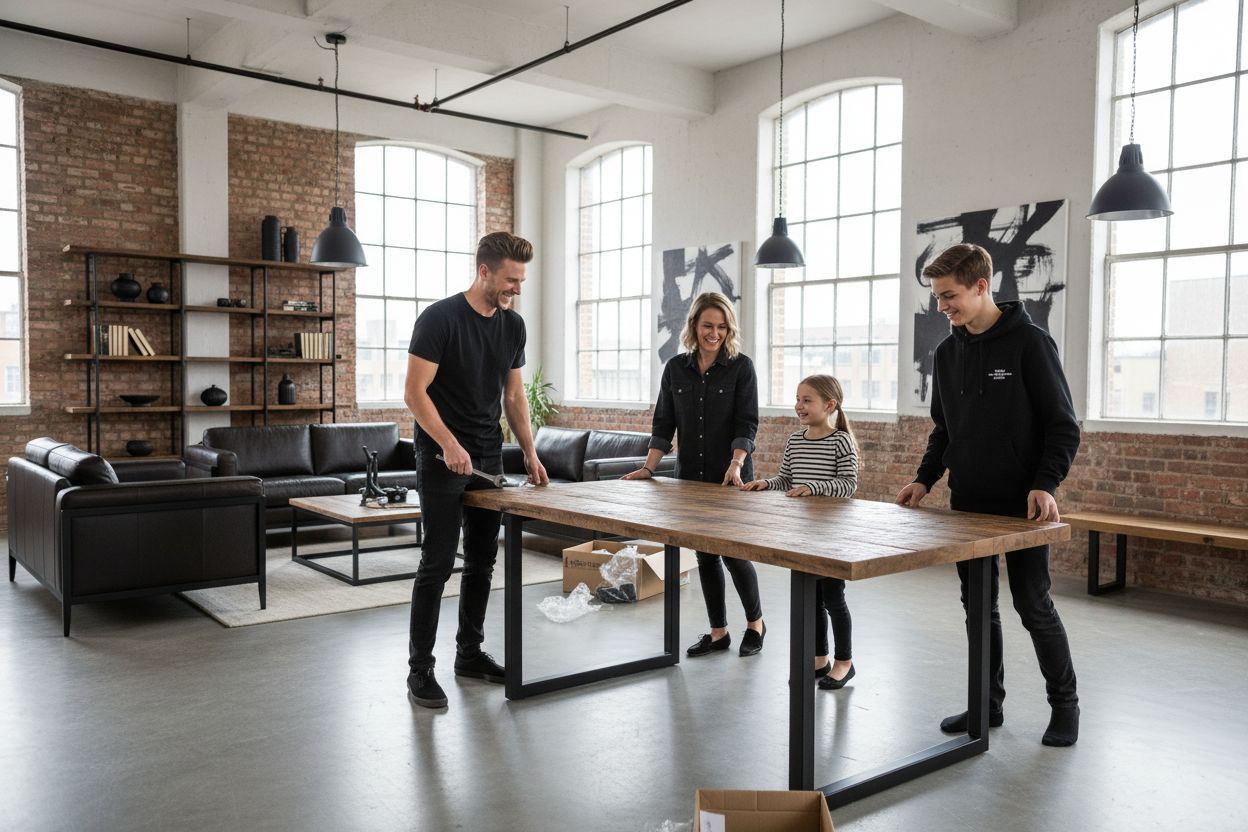
There is a particular satisfaction in living with furniture that truly belongs to its space — not adjusted, not compromised, not almost right. A room with an angled ceiling, an unusual alcove, or a doorway that demands something specific does not need a showroom. It needs a workshop with the skill to build exactly what is required. That is the idea behind Manufaktur X: individually crafted pieces in steel, glass, and solid wood, produced to your precise measurements by hand.
What Defines the Industrial Design Aesthetic?
Industrial style is not a passing trend. It is a design philosophy with deep roots — one that emerged when redundant factories and warehouses across Europe were converted into living spaces during the 1970s and 1980s. The first residents did not hide the bones of these buildings. They kept the exposed beams, the bare brickwork, the steel columns, and built their lives around them. What started as pragmatism became a recognised aesthetic language.
The defining principle is honesty about materials and construction. Welds, bolts, wood grain, steel profiles — these are not flaws to be concealed. They are the design. Every element should earn its place, and nothing purely decorative deserves a seat at the table.
The Core Characteristics of Industrial Style
- Raw, honest materials: Steel, solid wood, concrete, and glass — chosen for their natural character, not their ability to imitate something else
- Visible construction: Joints, fixings, and structural elements are part of the visual language, not hidden behind cladding
- Functional aesthetics: Every component has a clear purpose — "form follows function" taken seriously
- Patina as a quality indicator: Marks of use are welcomed as evidence of a life lived, not treated as damage
- Restrained colour palette: Anthracite, black, rust, grey, and warm earth tones — colours that let materials speak for themselves
| Characteristic | Role in Industrial Style |
|---|---|
| Material honesty | Steel, solid wood, glass; natural textures left visible |
| Structural transparency | Visible joints, bolts, and frames as deliberate design features |
| Colour language | Grey, rust, anthracite, black, earth tones — authenticity over decoration |
| Surface treatment | Minimal processing, natural ageing, raw aesthetic |
| Functional logic | Every element justifies its presence; no superfluous ornament |
Variations on the Industrial Theme
Industrial style is not monolithic. It adapts to different spaces, climates, and personal preferences. The six most recognised variations are:
- Classic Industrial: Maximum rawness — original factory elements, exposed masonry, heavy steel frames
- Modern Industrial: A cleaner, more refined interpretation with precise lines and contemporary fittings
- Urban Loft: Softer shapes, textile accents, and lighter surfaces for a more relaxed atmosphere
- Rustic Industrial: Heavily wood-focused, with aged and reclaimed materials taking centre stage
- Industrial-Scandinavian: The warmth of Nordic design softens the harder edges of industrial aesthetics
- Industrial-Vintage: Combines rough textures with nostalgic or retro-influenced objects
Why Choose Custom-Made Over Off-the-Shelf?
Standard furniture is designed for an imaginary average room occupied by an imaginary average person. Real homes are rarely average. Walls lean slightly. Ceiling heights vary. Doorways do not conform to catalogue dimensions. When furniture is built specifically for your space, the difference is immediately obvious — and permanent.
Precision Fit and True Individuality
A custom loft door that sits perfectly flush in its opening looks categorically different from one that has been shimmed and filled to approximate a fit. Custom industrial furniture is made as a one-off — your dimensions, your material choices, your finish. Nothing is adapted from an existing standard; everything begins with your requirements.
Material Quality That Lasts Generations
Solid wood and steel outlast particle board, veneer, and plastic by decades. More than that: they improve with time. The surface of an oak table that has been used daily for fifteen years carries a history. That is not wear — that is character. Industrial design celebrates this quality rather than treating it as a defect.
A Sustainable Approach to Furnishing
Buying once and keeping for decades is one of the most straightforward sustainability choices available. Custom furniture made from solid materials resists the cycle of replacing flat-pack pieces every few years. It is an investment in longevity — and a quiet rejection of the throwaway model that dominates mass retail.
| Aspect | Custom Industrial Furniture | Mass-Produced Furniture |
|---|---|---|
| Individuality | Unique pieces, built precisely to your specifications and space | Standardised designs with minimal personalisation |
| Material quality | Solid wood, steel, safety glass | Typically particle board, veneer, or cheaper alternatives |
| Design philosophy | Authenticity, raw beauty, functional logic | Trend-driven or purely functional, rarely both |
| Longevity | Decades of use; develops character over time | Short lifespan; designed for replacement |
| Production | Skilled craftsmanship combined with modern precision | Industrial mass production |
Materials and Finishes: What Manufaktur X Works With
The credibility of industrial design depends entirely on the materials used. Imitation does not work here — the aesthetic only holds when the materials are genuinely what they appear to be. At Manufaktur X, the palette is deliberately limited: solid wood, steel, and — for loft doors and room dividers — glass.
Solid Wood: Oak, Beech, Pine, Ash, Walnut, and Cherry
Every piece of wood used at Manufaktur X is solid hardwood — no engineered boards, no veneers. Oak, beech, ash, and other hardwoods from the range bring natural density, pronounced grain, and the kind of durability that improves rather than deteriorates with age. For finishing, more than 50 stain options are available, ranging from pale natural tones through to deep, dark shades that complement a steel frame perfectly.
Steel Frames: Powder Coating in Any RAL Colour
All steel components are finished using powder coating — a process that delivers a scratch-resistant, evenly coloured surface without the environmental drawbacks of solvent-based paints. The result is durable, consistent, and suited to daily use. Anthracite (RAL 7016), matte black (RAL 9005), and white (RAL 9010) are the most popular choices, but any RAL colour is available for those who want something more specific.
Glass: Five Options for Loft Doors and Room Dividers
Glass is used exclusively in the steel-and-glass products — the loft door and the room divider. Five glass designs are available in the configurator:
- Clear glass — full transparency and maximum light passage
- Frosted glass — soft privacy screening while still allowing light through
- Smoked glass — a tinted look with mild privacy effect
- Dark smoked glass — stronger tinting for greater privacy
- Textured glass — a patterned surface that scatters light attractively
In terms of glass type, both ESG (toughened safety glass) and VSG (laminated safety glass) are available. For larger dimensions in height or width, VSG is recommended for additional stability and security.
The Full Product Range
Every product at Manufaktur X is built to order in the EU, using solid wood, steel, and safety glass. The range divides into two families: steel-and-glass pieces and steel-and-solid-wood pieces.
Loft Door — A True Steel and Glass Door, Made to Measure
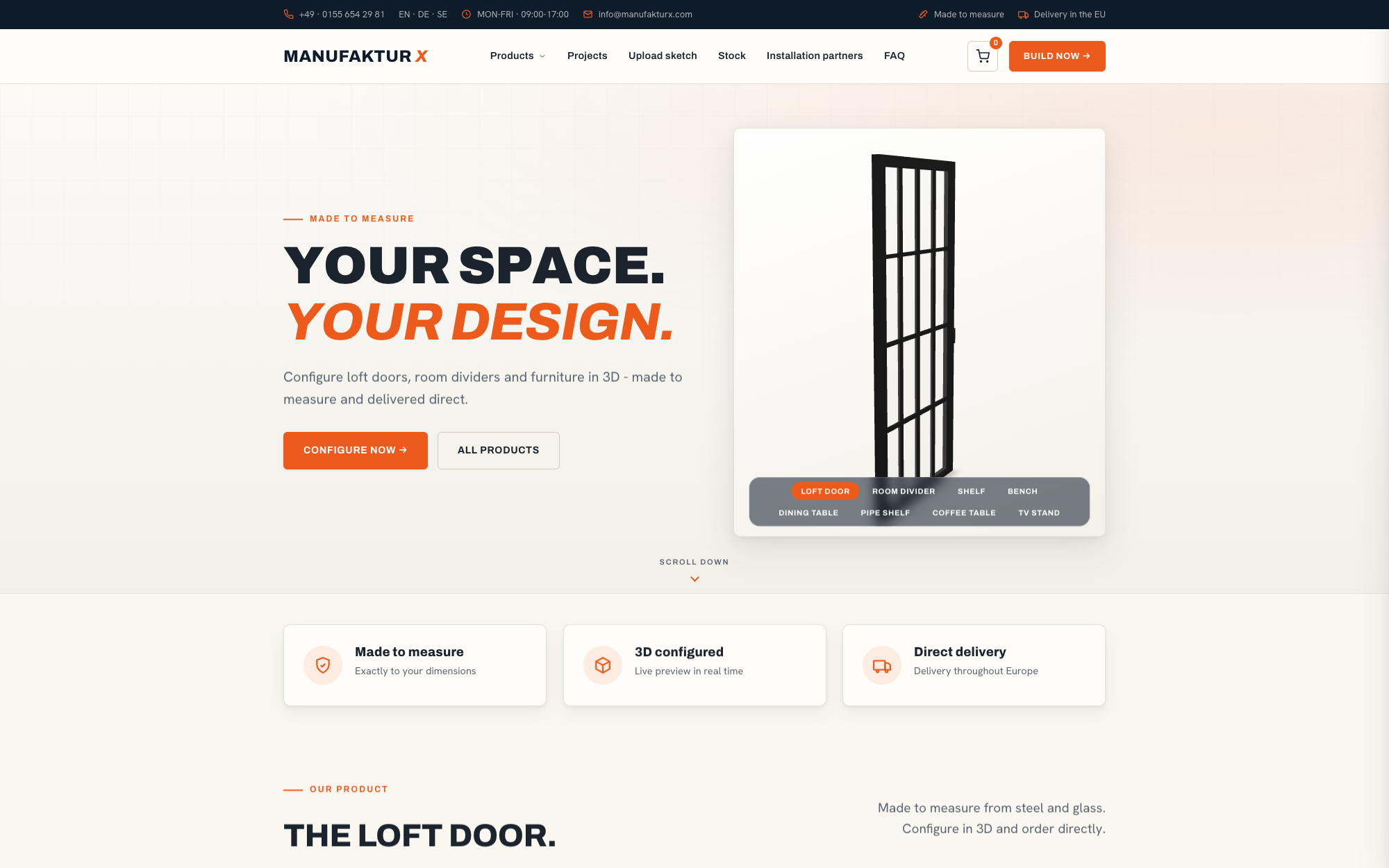
The loft door is a functioning hinged door with a defined swing direction (left or right), configurable opening angle, and a choice of three handle designs: Long, Discreet, and Half-Moon. Slender steel profiles, generous glass surfaces, and a clean factory aesthetic — starting from €1,157 for the entry-level configuration.
Room Divider — A Fixed Steel and Glass Partition
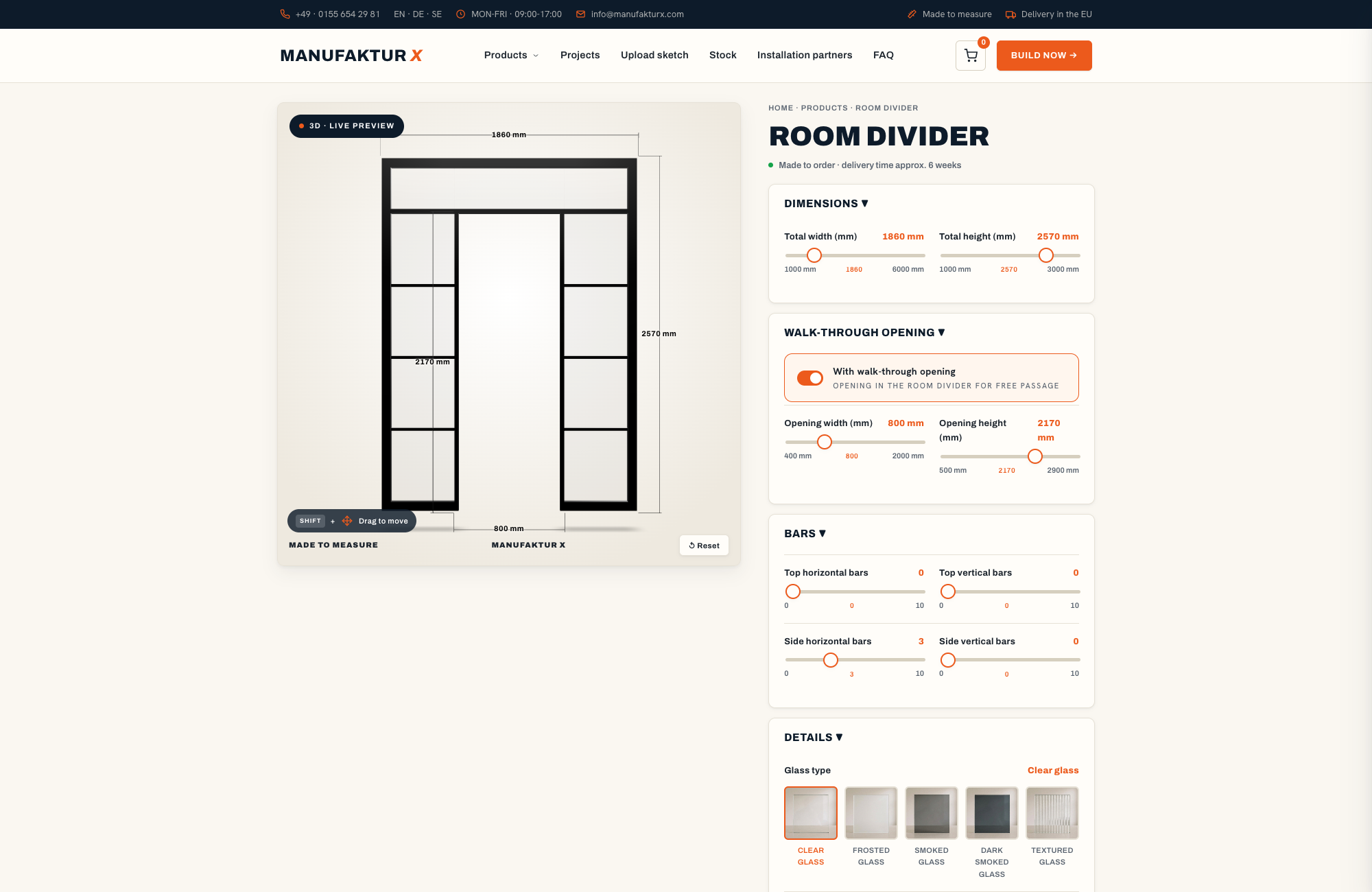
The room divider is a permanently installed steel-and-glass partition — not a door, not a movable panel. There are no hinges, no handles, no swing direction. If a walkthrough is needed, an open passageway can be incorporated as a frameless gap within the structure. The divider reorganises open floor plans without closing them off, and the glass panels keep light flowing freely between zones.
Large Shelf — Steel Frame with Solid Wood Shelves
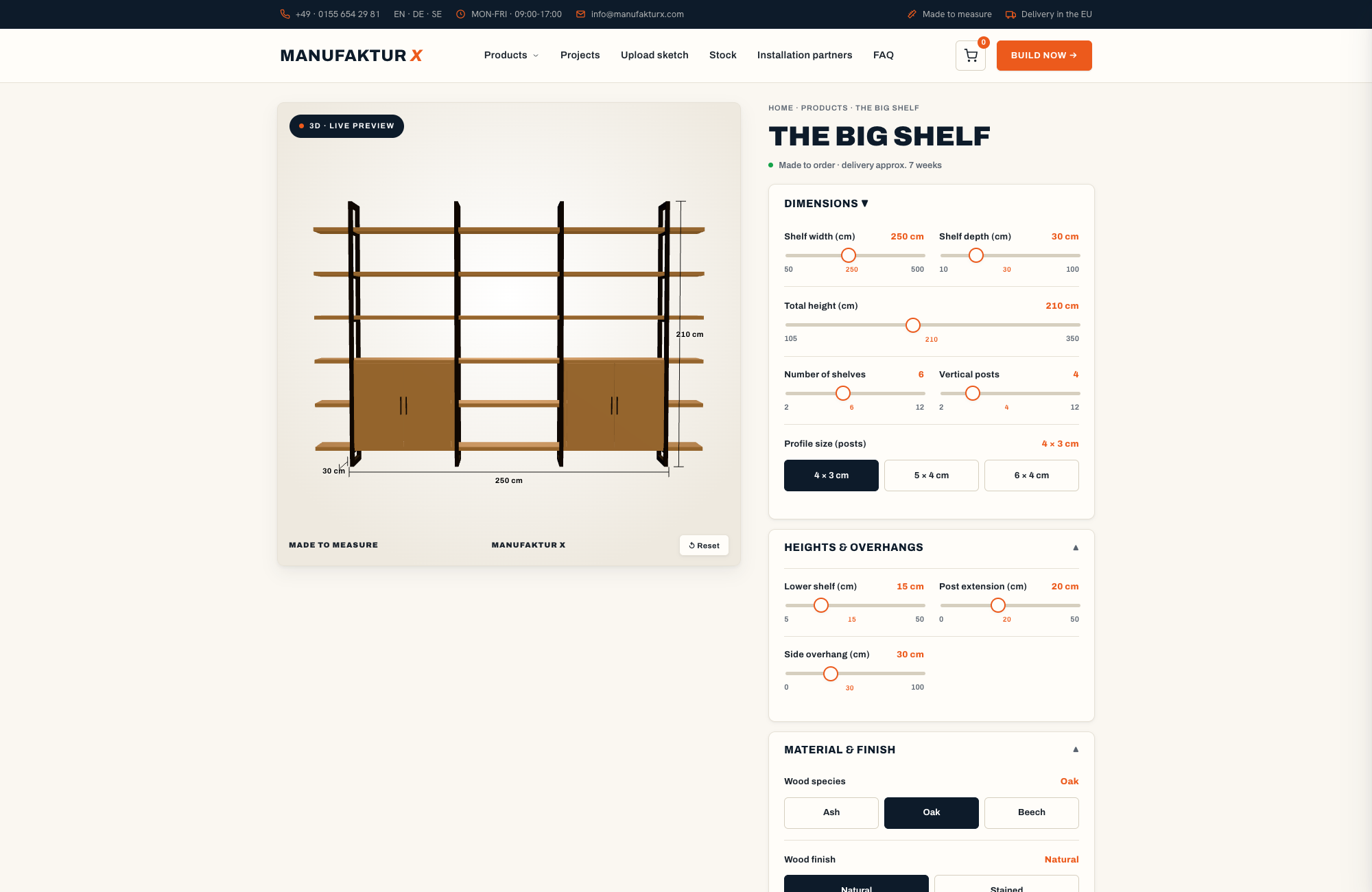
The large shelf pairs a powder-coated steel frame with solid wood shelf panels. Optional integrated wooden cabinets add enclosed storage. No glass is involved — this is a pure steel-and-solid-wood construction that functions equally well as a room divider, wall-mounted storage, or freestanding shelving unit.
Dining Table and Coffee Table — Solid Wood on a Steel Base
The dining table and coffee table share the same logic: a solid wood top — oak, beech, ash, or another available hardwood — mounted on a powder-coated steel base. Two materials, no shortcuts. The wood grain is visible, the steel structure is honest, and the combination is as characterful as industrial design requires.
Bench — Solid Wood and Steel
The bench brings the same material discipline to seating: solid hardwood surface, steel frame, straightforward construction. It works as a standalone piece or as a natural companion to the dining table for a cohesive industrial ensemble.
Pipe Shelf — Steel Tube and Solid Wood
The pipe shelf is perhaps the most direct expression of industrial design in the range. Steel tubes act as the structural element, solid wood panels provide the shelving surfaces, and every connection is left visible. No glass, no concealment — just honest construction.
Five Trends Shaping Industrial Custom Furniture Right Now
The way people approach industrial design in their homes is evolving. These five directions are particularly prominent across European interiors at the moment.
1. Deliberate Minimalism
Fewer pieces, better chosen. The industrial aesthetic has always leaned towards restraint, but current interpretations push this further — monochrome palettes broken by a single material contrast, rooms structured by a loft door or partition rather than filled with furniture. The glass panel becomes the room's defining feature rather than a background element.
2. Sustainability as a Design Value
Longevity is increasingly understood as a design choice. Solid wood and powder-coated steel are not simply aesthetic materials — they are materials that last. This is not marketing language; it is straightforward material science. Oak hardens with age. Powder coating resists daily abrasion without flaking. Choosing materials built to endure is increasingly part of a considered approach to sustainable living across Europe.
3. Digital Configuration, Artisan Production
The combination of online configurators with genuine workshop craftsmanship has changed how custom furniture is ordered. In the Manufaktur X configurator, you enter your exact desired dimensions, choose materials, select a frame colour, and see the price update in real time. There are no hidden costs and no waiting for a quote — the full picture is available immediately, with delivery and production details visible at checkout.
4. Flexible Spaces for Modern Working Life
Across Europe, the shift towards hybrid working has changed how people think about their homes. A space that serves as a home office by day and a living room by evening requires thoughtful division — not walls, but structure. Custom loft doors and room dividers answer this need precisely: they define zones, manage sight lines, and allow light to continue moving through the space.
5. Visible Craft as a Counter-Statement
As mass production becomes ever more ubiquitous, the visible marks of skilled making carry increasing value. A weld seam, a hand-applied stain, a custom dimension — these details signal that a piece was made by someone for someone, not produced by an algorithm for an average. That distinction is the heart of custom industrial furniture.
Bringing Industrial Design into Your Home, Room by Room
You do not need a converted warehouse or a double-height ceiling to live with industrial design convincingly. The aesthetic scales remarkably well — the key is understanding balance.
Structuring Open Floor Plans
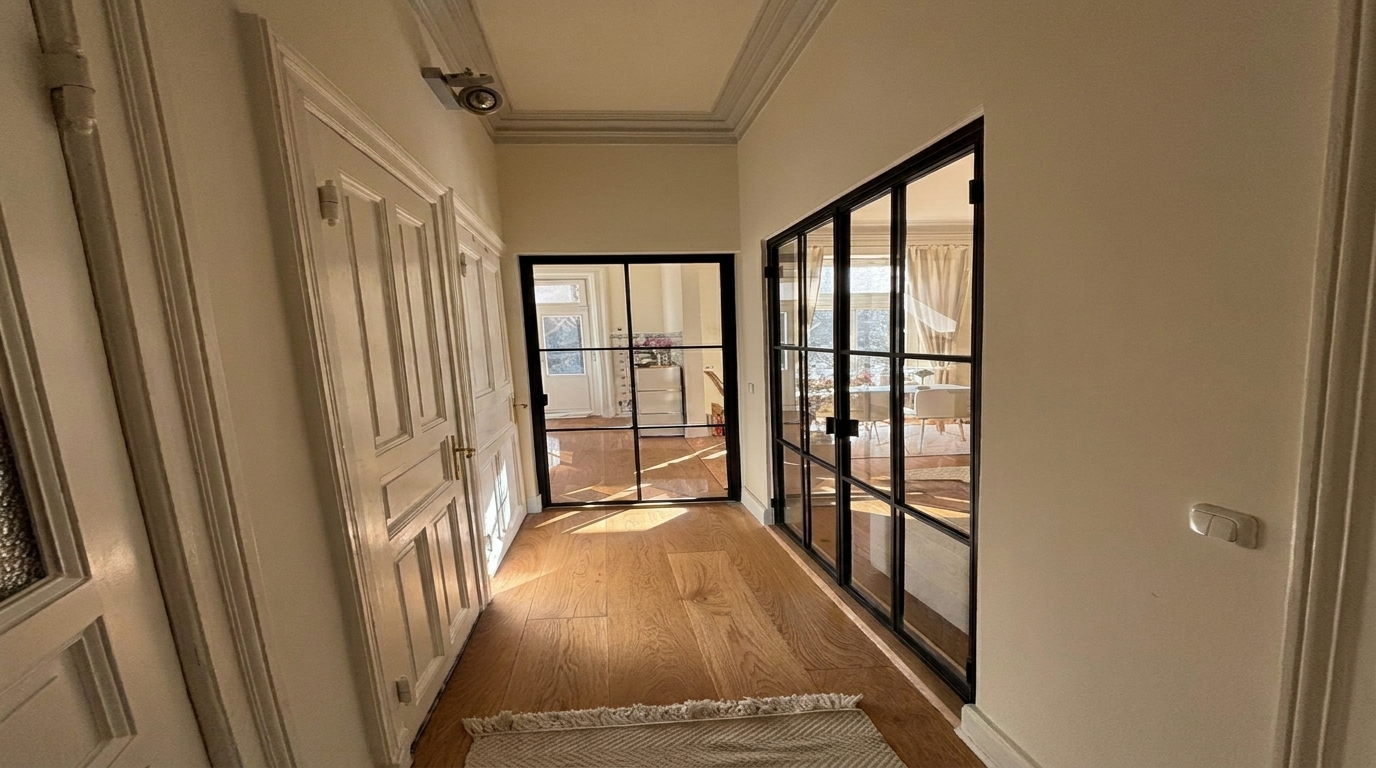
Open-plan living is a natural home for industrial aesthetics, but large undivided spaces sometimes benefit from considered boundaries. A steel-and-glass partition creates definition without closing the space down — light continues to move through the glass panels while the frame provides the visual structure that an open room often needs.
The distinction between products matters here: the room divider is a fixed installation, appropriate when a permanent spatial arrangement is the goal. The loft door is a functioning door, appropriate when flexible opening and closing between spaces is needed. Both use the same steel-and-glass construction language; they serve fundamentally different purposes.
Combining Materials Effectively
- Steel: As frames, shelf structures, or table bases — powder-coated for longevity, or left with a natural patina where appropriate
- Solid wood: As table tops, shelf panels, or bench seats — stained or oiled to bring out the grain
- Concrete and stone: As flooring or feature walls — raw and untreated for maximum industrial credibility
- Glass: In combination with steel frames for loft doors and partitions — clear, frosted, smoked, or textured depending on the privacy required
The appeal of these combinations lies in contrast: warm against cold, soft against hard, organic against geometric. That tension is what gives industrial interiors their particular energy.
Using Colour with Restraint
Greys in various depths, black as an anchor, rust and warm browns for softness, white for contrast where needed. Bold colours, if used at all, work as isolated accents — a single object rather than a surface. The powder coating on steel frames is available in any RAL colour, but the industrial palette remains the natural home of this aesthetic.
Adding Warmth Without Losing Character
Industrial interiors can feel cold if the rawness is not balanced with softer elements. The materials themselves provide the structure; the comfort comes from considered layering:
- Generous seating upholstered in leather or heavy linen
- Natural textiles — wool throws, cotton cushions, jute rugs
- Indoor plants as organic contrast to steel and glass surfaces
- Warm-toned lighting: filament bulbs, metal-shaded pendants, directional spots
- Vintage or found objects that carry their own history
Industrial Style in Smaller Spaces
Compact apartments can carry industrial design convincingly when the approach is selective. A few strong material choices deliver more than an attempt to replicate the full warehouse aesthetic at reduced scale:
- Wall-mounted pipe shelves with visible steel brackets maximise storage without consuming floor space
- Loft doors with glass panels keep smaller rooms feeling open and connected to light
- Light-coloured wall surfaces reflect natural light and prevent the space from feeling heavy
- One exposed brick or concrete surface can establish the industrial character of an entire room
How a Custom Piece Is Made: The Process at Manufaktur X
The production process combines traditional workshop skills with modern precision tooling — the result of that combination is furniture that could not be made any other way.
Step One: Measuring Your Space
Accurate measuring is the foundation of a successful custom piece. Take measurements at multiple points — walls and floors are rarely perfectly flat, and the smallest measurement is always the one that matters. For loft doors specifically, allow for an installation gap of approximately 5 mm on each side (left, right, and top). The dimensions you enter in the configurator are the exact dimensions to which your piece will be built — not a rough opening size, but your precise desired measurement.
Step Two: Configuring Online
The online configurator at manufakturx.com lets you work through every decision in sequence: dimensions, wood species, stain, frame colour, glass design, glass type, and any additional options. The price updates with each change — no waiting, no negotiation, no surprise invoice later. Production time and delivery information are shown transparently at checkout.
Step Three: Custom Requests via Sketch
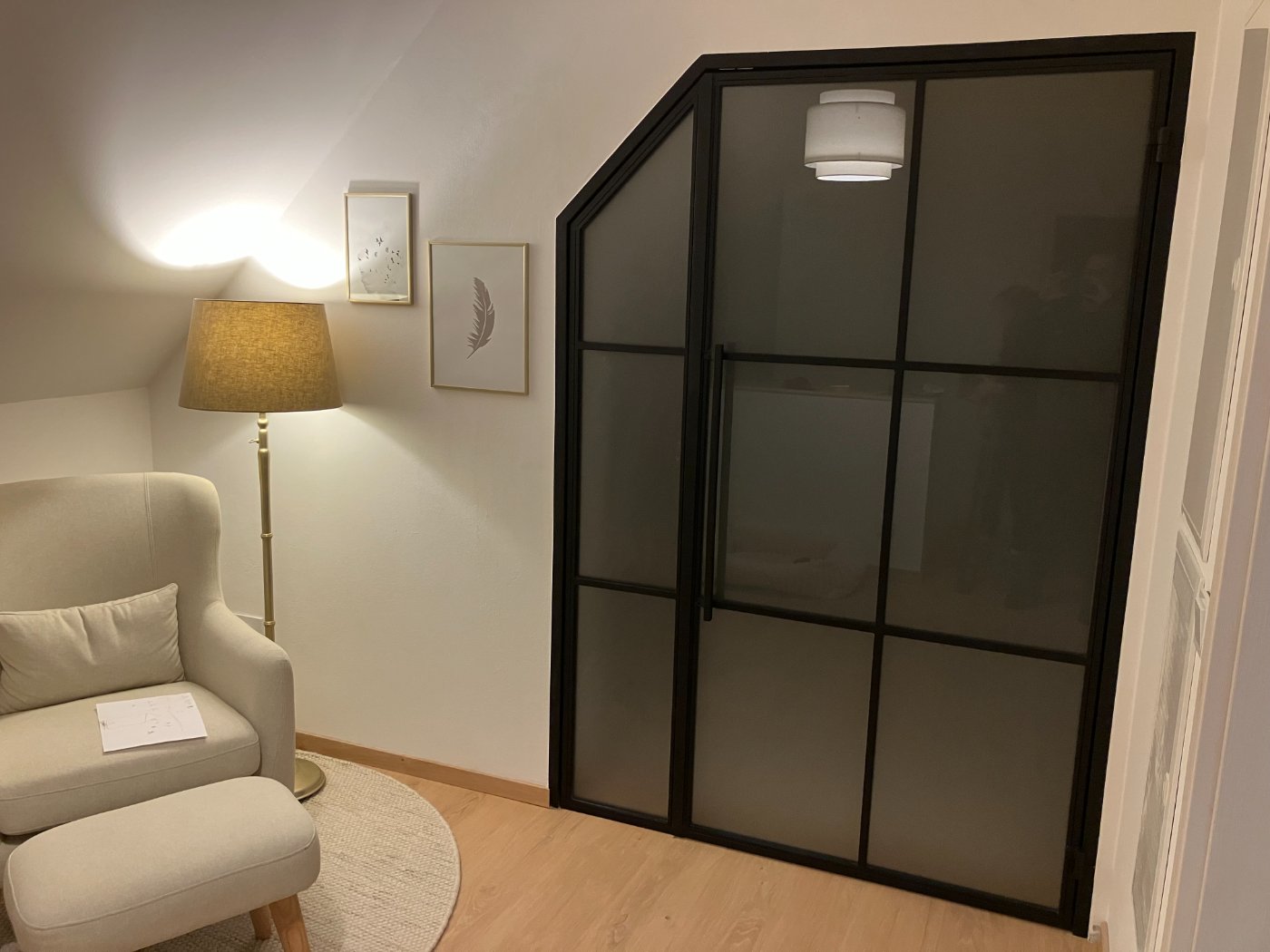
Some spaces do not fit standard configurator logic — an angled ceiling, a curved wall, an unusual structural element. For these situations, you can upload a sketch and request an individual quote directly through the website. The team reviews the technical feasibility and responds with a tailored proposal.
Step Four: Production and Delivery
Once the order is confirmed, production begins. The process moves from CAD design through CNC cutting and shaping to manual finishing and quality checking. Production takes 5–6 weeks, after which the finished piece is delivered directly to your address. Every item is built to the dimensions submitted — not to what happens to be in the workshop that week.
Loft Door vs. Room Divider: Understanding the Difference
These two products are frequently confused, and the confusion is understandable — they look similar and share the same material language. However, they serve fundamentally different functions.
| Feature | Loft Door | Room Divider |
|---|---|---|
| Function | A real door — opens and closes | A fixed partition — permanently installed |
| Hinges | Yes | No |
| Swing direction | Configurable (left or right) | Not applicable |
| Handle | Yes (Long, Discreet, or Half-Moon) | No |
| Passageway | Created by opening the door | Optional open gap built into the frame |
| Glass options | 5 designs (Clear, Frosted, Smoked, Dark Smoked, Textured) | 5 designs (Clear, Frosted, Smoked, Dark Smoked, Textured) |
| Frame colours | Any RAL colour, powder coated | Any RAL colour, powder coated |
Industrial Design as a Discipline vs. Industrial Style as an Aesthetic
The term "industrial design" carries two distinct meanings that are worth separating. As a professional discipline, industrial design is a strategic process concerned with the development of products — balancing functionality, usability, ergonomics, and economic viability. It is interdisciplinary and user-centred, operating at the intersection of engineering, psychology, and commerce.
As an interior aesthetic, "industrial style" refers to a specific visual language: raw materials, visible structure, functional logic, and an honest approach to construction. When the term appears in the context of custom furniture, it is this second meaning that applies — furniture designed and built according to industrial aesthetic principles. That is the territory Manufaktur X works in.
| Aspect | Industrial Design (Discipline) | Industrial Style (Interior Aesthetic) |
|---|---|---|
| Focus | User experience, function, commercial viability | Aesthetic of industrial materials and exposed construction |
| Goal | Functional and appealing products for broad use | Authentic, characterful living spaces |
| Materials | Varied — whatever the product requires | Steel, solid wood, concrete, glass |
| Process | Research, prototyping, testing, manufacture | Material selection, skilled craftsmanship, custom production |
Caring for Your Industrial Furniture
Custom pieces built from solid materials are durable by nature — but appropriate care extends that durability considerably. The good news is that industrial furniture requires very little maintenance.
Solid Wood Care
- Oil or wax the surface periodically to keep the wood supple and resistant to moisture
- Avoid prolonged direct sunlight and extreme dry conditions, which can cause movement in the wood
- Minor surface scratches can be addressed by light sanding followed by re-oiling
- Wipe up liquids promptly — solid wood is robust, but not impervious to water over time
Powder-Coated Steel Care
- Powder-coated surfaces are easy to clean — a damp cloth is sufficient for routine maintenance
- Avoid abrasive cleaners or harsh chemical products that can degrade the coating
- Any chips or scratches in the coating should be touched up promptly to prevent rust from developing beneath the surface
Glass Care
- Clean ESG and VSG panels with a standard glass cleaner and a lint-free cloth
- Do not use abrasive materials on glass surfaces
- On clear glass, fingerprints are most visible — a quick regular wipe keeps the panels looking their best
Pricing: What Does a Custom Piece Cost?
The entry-level loft door configuration starts at €1,157. The exact price depends on dimensions, glass design, handle selection, and any additional options — all of which are reflected in real time as you work through the configurator. For all other products in the range, current starting prices are available directly in the configurator or in the price overview.
| Product | From | Note |
|---|---|---|
| Lofttür | 1.157 € | Lowest possible option |
| Raumteiler | 2.212 € | Steel + laminated glass, custom width |
| Großes Regal | 3.200 € | Solid wood, steel frame, floor-to-ceiling |
| Esstisch | 1.580 € | Solid wood, steel frame |
| Couchtisch | 1.155 € | Solid wood, steel frame |
| Sitzbank | 1.100 € | Solid wood, steel frame |
| TV-Board | 1.540 € | Solid wood, steel frame |
| Rohrregal | 1.065 € | Modular pipe shelf |
Configure Your Piece: Where to Start
The most direct path from idea to order is the online configurator. Enter your exact desired dimensions, work through the material and finish options, and see the full price — including delivery — before you commit to anything. Changes are reflected immediately, so experimenting with different configurations costs nothing.
For spaces that require something outside the standard configurator options, the sketch upload service allows you to describe your specific situation and receive a tailored quote. If you have questions before starting, the FAQ section covers the most common topics in detail.
Custom furniture built to your exact dimensions, from solid materials, made in the EU — that is what Manufaktur X delivers, for every piece in the range.
Frequently Asked Questions
What makes custom industrial furniture different from standard furniture?
Custom industrial furniture is built as a one-off piece to your exact specifications — your dimensions, your material choices, your finish. Unlike mass-produced furniture, it is not adapted from a standard size. The materials used — solid hardwood and powder-coated steel — are also fundamentally different from the particle board and veneer typical of flat-pack products.
Which wood species are available?
Solid hardwoods available include oak, beech, pine, ash, walnut, and cherry. All are used as genuine solid wood — no engineered boards or veneers. More than 50 stain finishes are available for colour customisation.
What is the difference between a loft door and a room divider?
A loft door is a functioning hinged door with a swing direction (left or right), configurable opening angle, hinges, and a handle in one of three designs (Long, Discreet, or Half-Moon). A room divider is a fixed, permanently installed steel-and-glass partition with none of these elements — no hinges, no handle, no swing direction. An open passageway can optionally be incorporated into the room divider's frame if access is needed.
What glass options are available?
Five glass designs are available for both loft doors and room dividers: clear glass, frosted glass, smoked glass, dark smoked glass, and textured glass. In terms of safety glass type, both ESG (toughened) and VSG (laminated) are available. VSG is recommended for larger dimensions.
How do I measure correctly for a custom piece?
Measure at multiple points and use the smallest measurement as your reference — walls and floors are rarely perfectly even, and your piece needs to fit the tightest point. For loft doors, factor in an installation gap of approximately 5 mm on each side (left, right, and top). The dimensions you enter in the configurator are the exact dimensions to which your piece will be built.
How long does production take?
Production takes 5–6 weeks from the point of order confirmation. This covers the full process from CAD design through CNC machining, manual finishing, and quality checking before dispatch.
What is the starting price for a loft door?
The entry-level loft door configuration starts at €1,157. The final price depends on the dimensions you enter, the glass design you select, the handle style, and any additional options. All pricing is shown in real time in the configurator — no hidden costs, no separate quote required.
Can industrial design work in a smaller apartment?
Yes — and often very well. The key is selectivity: a few strong material choices deliver more visual impact than an attempt to reproduce the full aesthetic at reduced scale. A loft door with glass panels keeps a smaller room feeling open and well-lit. A pipe shelf with visible steel brackets adds industrial character without taking up floor space. One raw material surface — exposed brick, bare concrete — can set the tone for an entire room.